Rugby Betting Odds Explained: Fractional, Decimal and Implied Probability
 Available in US

Odds Are the Language of Betting — Here Is the Dictionary
A few years into my career as a rugby betting analyst, I sat next to a friend at a Six Nations match who told me he always backed the side with “bigger odds” because it paid more. He did not understand that bigger odds meant lower probability. He was not stupid — he was a qualified engineer. He simply had never been taught what odds actually represent. That conversation is the reason I write guides like this one.

Odds are the mechanism through which a bookmaker communicates two things simultaneously: the probability they assign to an outcome, and the price they are willing to pay you if that outcome occurs. Every bet you place is a transaction where you are buying a probability at a price. If the price is too high relative to the true probability, the bookmaker wins in the long run. If the price is too low, you win. Understanding odds is not optional — it is the prerequisite for everything else in rugby betting.
In the UK, roughly 10% of the adult population actively participates in online sports betting. A significant portion of those bettors have never calculated an implied probability from a set of odds. This guide exists to change that, one format at a time.
Fractional, Decimal and American: Same Odds, Different Labels
There are three odds formats you will encounter, and they all express the same underlying information. Fractional odds are the traditional UK format, decimal odds dominate in Europe and Australia, and American odds are standard in the United States. UK bookmakers typically default to fractional but allow you to switch between formats in your account settings.

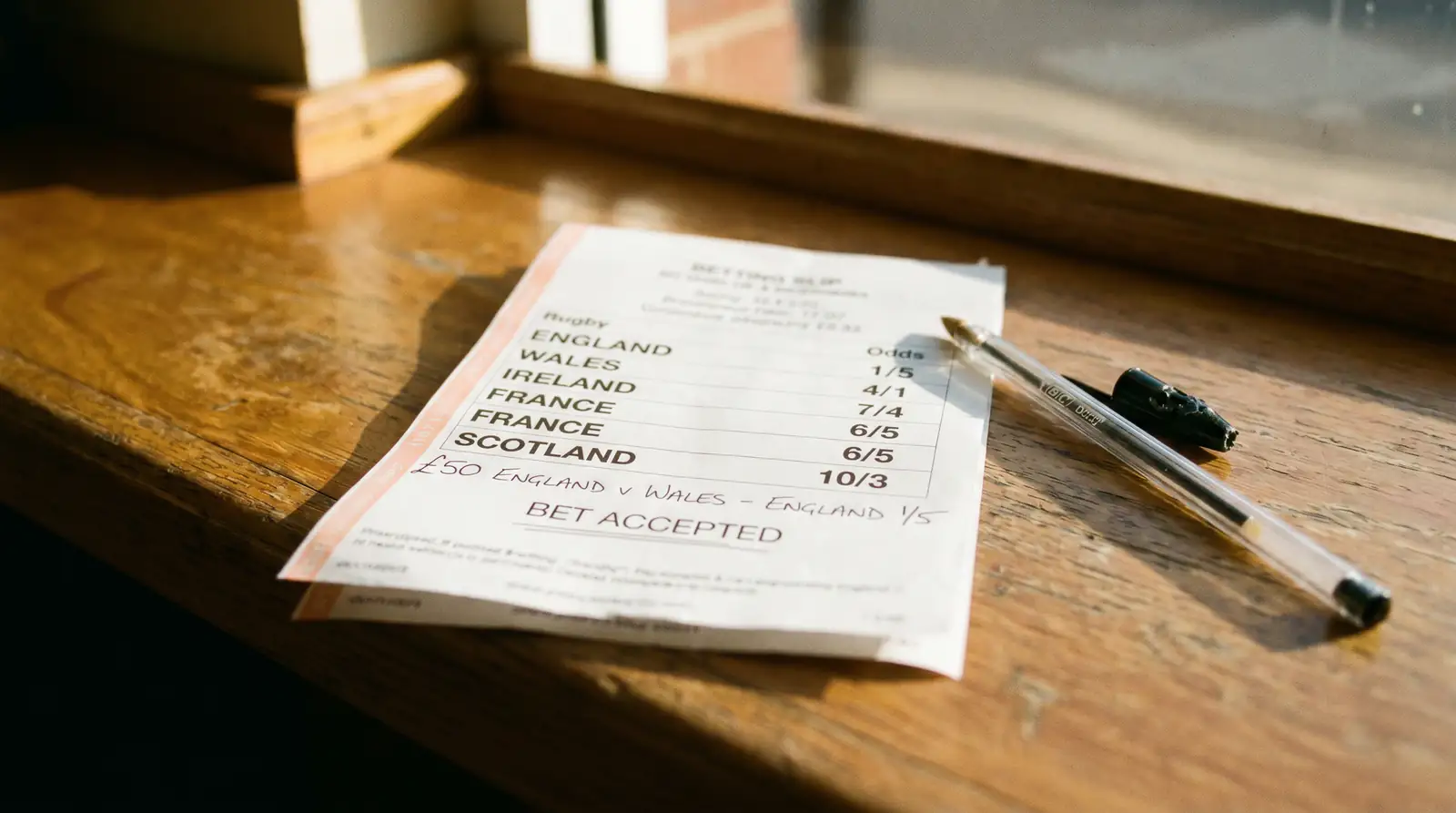
Fractional odds show your profit relative to your stake. If a rugby side is priced at 3/1, you receive three pounds of profit for every one pound staked, plus your stake back. A ten-pound bet at 3/1 returns forty pounds total — thirty profit plus ten stake. The fraction tells you the ratio: 3/1 means “three to one.” At 7/2, you receive seven pounds profit for every two pounds staked. A ten-pound bet at 7/2 returns forty-five pounds total.
Decimal odds express the total return per unit staked, including the stake itself. The equivalent of 3/1 in decimal is 4.00 — you get four pounds back for every one pound bet. To convert fractional to decimal, divide the numerator by the denominator and add one: 3 divided by 1 plus 1 equals 4.00. At 7/2, that is 3.5 plus 1 equals 4.50. Decimal is the cleaner format for calculations, which is why most professional bettors and analysts prefer it.
American odds use a baseline of 100. Positive American odds (like +300) tell you how much profit you make on a 100-unit stake: +300 means 300 profit on 100 staked, which is the same as 3/1 or 4.00 decimal. Negative American odds (like -150) tell you how much you need to stake to make 100 profit: -150 means you stake 150 to profit 100. You will rarely encounter American odds on UK rugby markets, but understanding them helps when comparing international bookmaker prices.
The critical insight across all three formats is that odds are not predictions — they are prices. A bookmaker does not set 3/1 because they believe the probability is exactly 25%. They set 3/1 because that price, combined with the prices on the other outcomes in the market, ensures their margin is built in regardless of the result. Sports betting commands a 57.1% share of UK online gambling revenue, and that revenue is built on the gap between the true probability and the odds offered.
Calculating Implied Probability From Any Odds Format
This is where odds become actionable. Every set of odds implies a probability — the bookmaker’s view of how likely an outcome is, before margin is applied. Knowing how to extract that number is what separates bettors who understand what they are buying from those who are guessing.
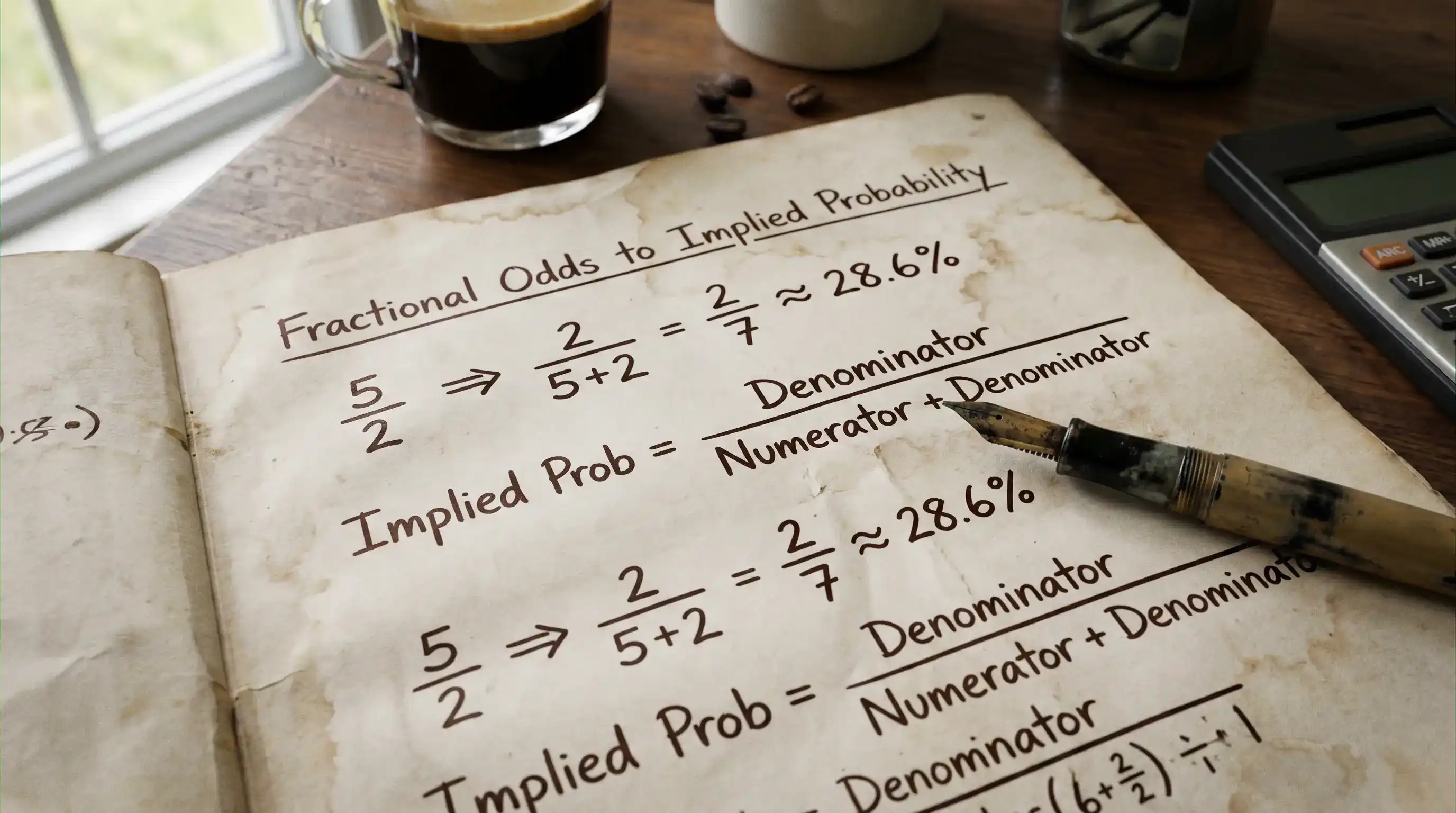
For fractional odds, the formula is: denominator divided by (numerator plus denominator), times 100. At 3/1: 1 divided by (3 + 1) times 100 = 25%. At 7/2: 2 divided by (7 + 2) times 100 = 22.2%. At 1/4: 4 divided by (1 + 4) times 100 = 80%.
For decimal odds: 1 divided by the decimal odds, times 100. At 4.00: 1/4.00 times 100 = 25%. At 4.50: 1/4.50 times 100 = 22.2%. At 1.25: 1/1.25 times 100 = 80%.
For American odds: if positive, 100 divided by (American odds + 100), times 100. At +300: 100/(300+100) times 100 = 25%. If negative, take the absolute value and divide it by (absolute value + 100), times 100. At -150: 150/(150+100) times 100 = 60%.
Once you can calculate implied probability in your sleep, you have a tool for every betting decision you will ever make. If your own assessment of a rugby match gives a side a 40% chance of winning, and the bookmaker’s implied probability is 30%, you have found a potential value bet. If your assessment is 25% and the market implies 30%, the price is too short and you pass. That comparison — your probability versus the market’s probability — is the entire foundation of profitable betting.
Where the Bookmaker Margin Hides — and How to Measure It
I once analysed a Six Nations match-winner market where the home side was 4/7 and the away side was 6/4. Those look like straightforward odds until you add up the implied probabilities: 4/7 implies 63.6%, and 6/4 implies 40%. Total: 103.6%. That extra 3.6% above 100% is the bookmaker’s margin, also called the overround or the vig. It is the house edge built into every market.

Measuring the overround is simple. Convert every selection’s odds to implied probability and add them up. If a two-way market totals 105%, the overround is 5%. If a tryscorer market with twenty players totals 165%, the overround is 65%. The higher the overround, the worse the deal for the bettor.
Overrounds vary significantly by market type. Head-to-head rugby markets (two outcomes, ignoring the draw) typically carry overrounds of 4-8%. Handicap and totals markets sit at 6-10%. Tryscorer markets, as I mentioned in the context of the rugby betting beginners guide, can exceed 150% because the large number of possible outcomes allows the bookmaker to build margin into every price without any single price looking unreasonable.
The practical implication is that market choice matters as much as selection. A bettor who consistently bets in low-overround markets — match winner, handicap — starts with a structural advantage over someone who gravitates toward high-overround markets like correct score or first tryscorer. The edge per bet might only be 2-3%, but compounded over hundreds of bets across a season, that margin difference determines whether your record is profitable or not.
To strip the margin from a set of odds and find the “true” implied probability, divide each selection’s raw implied probability by the total overround. In the example above: 63.6% divided by 103.6% = 61.4% true probability for the home side, and 40% divided by 103.6% = 38.6% for the away side. Those margin-stripped probabilities add to 100% and represent the bookmaker’s actual view of the match, before their house edge is applied. Comparing your own model’s output to these true probabilities is the cleanest way to identify where value exists.
Which odds format is most commonly used by UK rugby bookmakers?
Fractional odds remain the default display format at most UK bookmakers. However, nearly all operators allow you to switch to decimal or American odds in your account settings. Many professional bettors and analysts prefer decimal odds because they make return calculations and implied probability conversions simpler.
How do I convert fractional odds to implied probability?
Divide the denominator by the sum of numerator and denominator, then multiply by 100. For example, at 5/2: 2 divided by (5 + 2) = 0.2857, times 100 = 28.57% implied probability. This tells you the bookmaker considers this outcome to have roughly a 28.6% chance, before their margin is factored in.
Created by the ”Rugby Betting Tips” editorial team.