Live Rugby Betting Tips: In-Play Markets, Timing and Momentum Reads
 Available in US

Why the Best Rugby Value Often Appears After Kick-Off
The bet I am most proud of from last season was not placed the day before the match, or even that morning. It was placed at the 52nd minute of a Premiership fixture, when the away side had just conceded a soft try and the in-play handicap shifted by four points in ten seconds. The market overreacted to a moment. I had been watching the underlying performance indicators — territory, penalty count, set-piece stability — and they told a different story from the scoreboard. I took the adjusted handicap, and the away side came back to cover it comfortably. That is live rugby betting at its best: using real-time information the market has not yet priced in.
Pre-match markets are efficient. Bookmakers have days or weeks to set their lines, and the weight of public money corrects any initial mispricings before kick-off. In-play markets, by contrast, are priced under pressure. The odds algorithm reacts to events — tries, cards, penalties, substitutions — but it reacts to the scoreboard, not to the underlying dynamics of the match. A team dominating territory and possession but trailing on the scoreboard due to a single breakaway try will be undervalued by the in-play model. A team leading by a converted try but conceding penalty after penalty in their own half will be overvalued. Those disconnects between the scoreboard and the underlying game state are where live edges appear.
With 290.03 million online bets placed monthly on real events in the UK, a growing share is shifting to in-play markets across all sports. Rugby’s natural stoppages — scrums, lineouts, conversions, penalty kicks — create built-in windows where bettors can evaluate odds without the frantic pace of, say, live football. That structural advantage makes rugby one of the better sports for in-play betting, provided you know what to watch for.
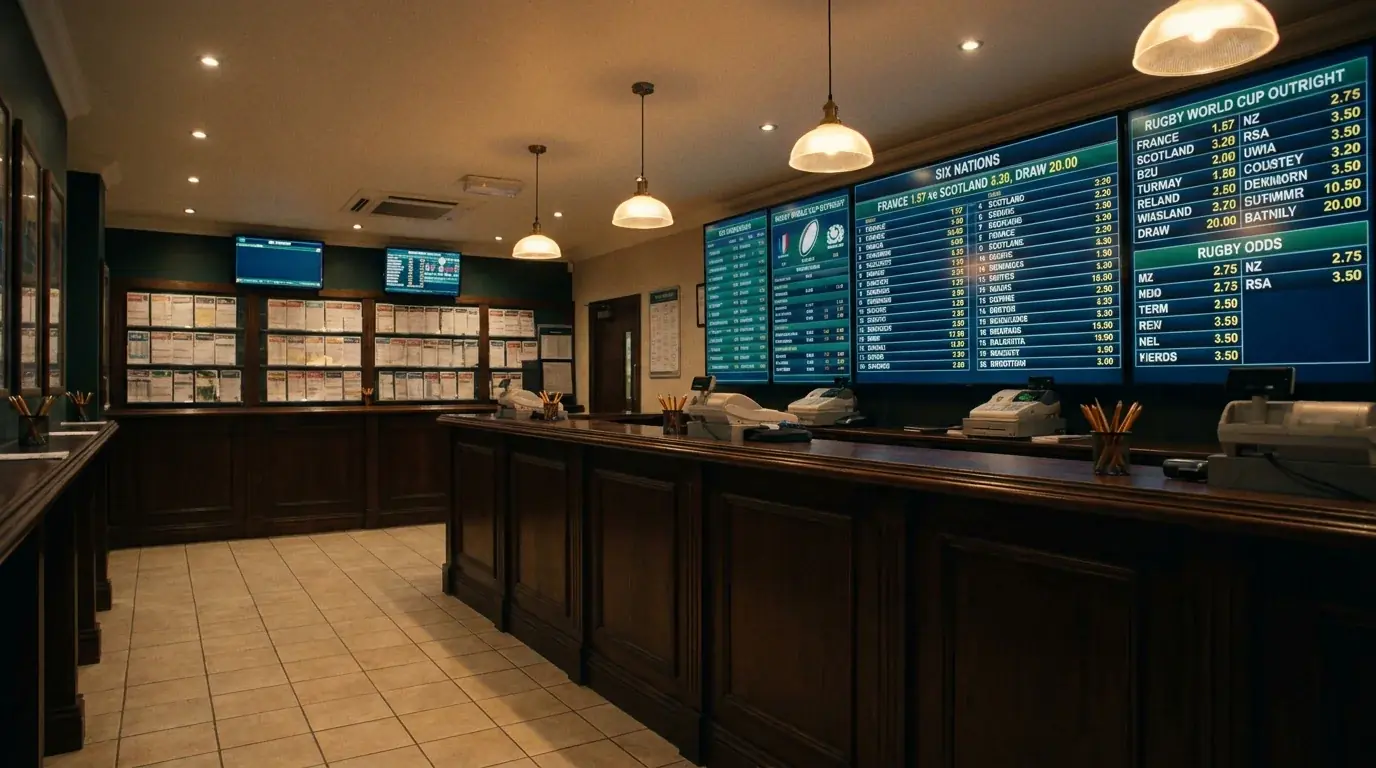
How In-Play Rugby Markets Are Priced
Every bookmaker uses an automated pricing model for in-play markets. Understanding how that model works — and where it breaks down — is the foundation of profitable live betting.
The model starts with the pre-match odds and adjusts in real time based on three primary inputs: the current score, the time elapsed and the next expected scoring event. When a try is scored, the model recalculates the probability of each outcome based on the new scoreline and the remaining time. A 7-point deficit at the 20th minute looks very different from the same deficit at the 70th minute, and the model reflects that by offering longer odds on the trailing team as the clock runs down.
Where the model struggles is with qualitative factors. It knows the score and the time. It does not know that the trailing team has had 65% territory for the last fifteen minutes. It does not know that the leading team’s fly-half just came off injured and the replacement has been unreliable under pressure. It does not know that the referee has penalised the leading team’s scrum three times in succession and a fourth infringement will almost certainly produce a yellow card. These are all factors that a human watching the match can assess and the algorithm cannot — at least not quickly enough to prevent a window of mispricing.

The suspension of markets is another key feature. When a try is being reviewed by the TMO (television match official), most operators suspend the in-play market entirely. No bets are accepted until the decision is confirmed. This protects the bookmaker from bettors who have already seen the replay and know the try will be awarded. The suspension typically lasts 30-60 seconds, and when the market reopens, the odds reflect the confirmed outcome. The practical lesson: do not waste time trying to beat the TMO suspension. Instead, focus on the periods of open play where the model is running but not yet adjusting to momentum shifts.
Cash-out offers are a derivative of the in-play pricing model. When a bookmaker offers you a cash-out figure on a pre-match bet, they are calculating the current implied probability of your bet winning based on the live odds and offering you a return that is lower than your potential payout by an amount that includes their margin. Cash out is always worse than the theoretical fair value of your position. That does not mean you should never use it — sometimes locking in a profit is the right decision — but you should understand that the cash-out strategy is a tool with a built-in cost, not a favour from the bookmaker.
Momentum Indicators Worth Watching
Score: 14-10, 55 minutes played, the away team have just taken a penalty to trail by only four. The in-play match-winner odds show the home side at 1.55, the away side at 2.80. Should you bet? Depends entirely on what you see beyond the scoreboard.
The single most reliable momentum indicator in live rugby is consecutive phases in the opposition half. A team stringing together 8, 10, 12 phases inside their opponent’s 22 is building pressure that the model does not fully capture until a scoring event occurs. Penalty count is the second indicator — three penalties conceded in the last ten minutes signals a team under sustained pressure, and a fourth infringement brings the real possibility of a yellow card. Territory percentage over the last fifteen minutes matters more than the overall match territory, because recent territory is forward-looking while cumulative territory is backward-looking.
Substitution patterns are the indicator most bettors overlook. When a team brings on their front-row replacements between 50 and 55 minutes in Union, the scrum dynamic can shift dramatically. A fresh tighthead prop against a tired loosehead is not a subtle advantage — it translates into scrum penalties, which translate into territory, which translate into points. If you are watching a match where one team has made their front-row swap and the other has not, the next ten minutes tend to favour the team with fresh legs in the scrum. The in-play model does not track substitution timing with this level of granularity.

Kicking from hand is another live signal. A fly-half or full-back who starts kicking for territory rather than running or passing is signalling that their team is under pressure and trying to exit their own half. Increased kicking frequency in the second half — particularly aimless clearance kicks that concede possession — is a reliable precursor to conceding points. If the team you backed pre-match starts kicking the ball away from structured play, the momentum has turned against them, and the in-play market probably has not caught up yet.
One more: the scrum reset. In Union, repeated scrum resets — the referee ordering the scrum to be set again after a collapse or early engagement — indicate that one pack is struggling. Referees tend to penalise the team they believe is at fault after two or three resets, and that penalty can cascade into a yellow card if the infringements persist. Watch for the referee’s body language at scrum time. If they are speaking to one front row more than the other, the penalty is coming, and the in-play penalty count market is about to move.
Yellow-Card Windows and Numerical Advantage Betting
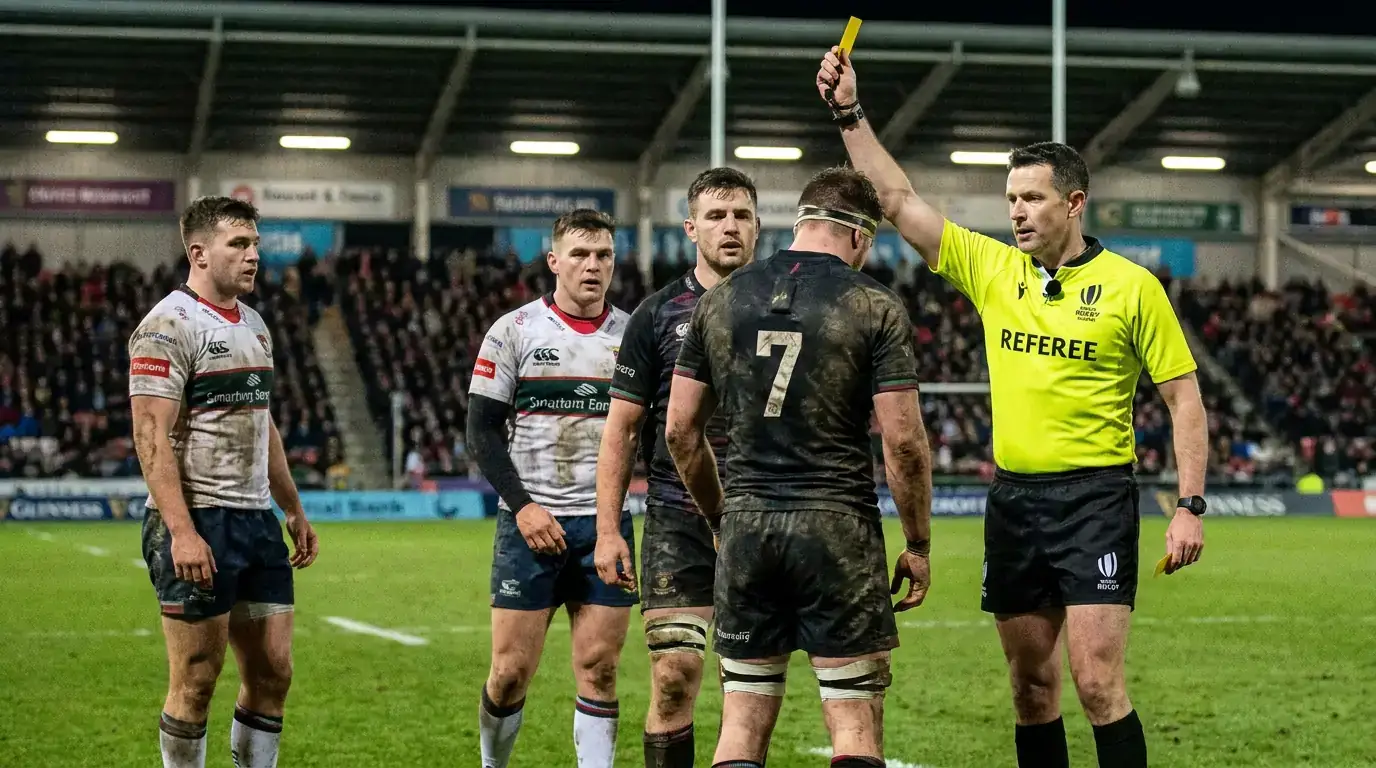
A yellow card in rugby is not just a disciplinary sanction — it is a ten-minute betting window that reshapes the entire in-play market. I have built a disproportionate share of my live rugby profits around these windows, and the reason is simple: the in-play model underestimates the impact of numerical advantage.
When a player is sent to the sin bin, the offending team drops from 15 to 14 players (in Union) or 13 to 12 (in League). The in-play odds adjust, but they adjust based on historical averages of how much a team is disadvantaged by a yellow card. Those averages mask the reality that the impact depends heavily on which player is carded, at what point in the match, and how the opposition chooses to exploit the extra man. A yellow card to a back-row forward at the 60th minute, when the team with the advantage has fresh replacements on the bench, creates a far larger scoring probability than a yellow card to a wing at the 15th minute.
Sportradar monitors over one million sporting events annually across 70 different sports, identifying irregularities in betting patterns that could signal integrity concerns. Their analysis flags that more than 99.5% of monitored events show no suspicious activity — a figure that should give UK bettors confidence in the legitimacy of the markets they are betting into. But the relevant insight for live bettors is that legitimate events produce legitimate momentum shifts, and yellow cards are the most predictable and exploitable of those shifts.
My approach: when a yellow card is issued, I immediately check the in-play next-try-scorer and next-scoring-method markets. The team with the numerical advantage is priced as more likely to score next, but the odds on the specific scoring method — penalty goal versus try — often lag behind the tactical reality. If the team with the extra man is camped on the opposition try line, the next score is overwhelmingly likely to be a try, and the in-play odds on “next score: try” may still reflect pre-card probabilities. That gap is your window.
When to Enter and When to Wait
Timing an in-play bet is as important as the selection itself. Place it too early and you are betting on incomplete information. Place it too late and the market has already adjusted.
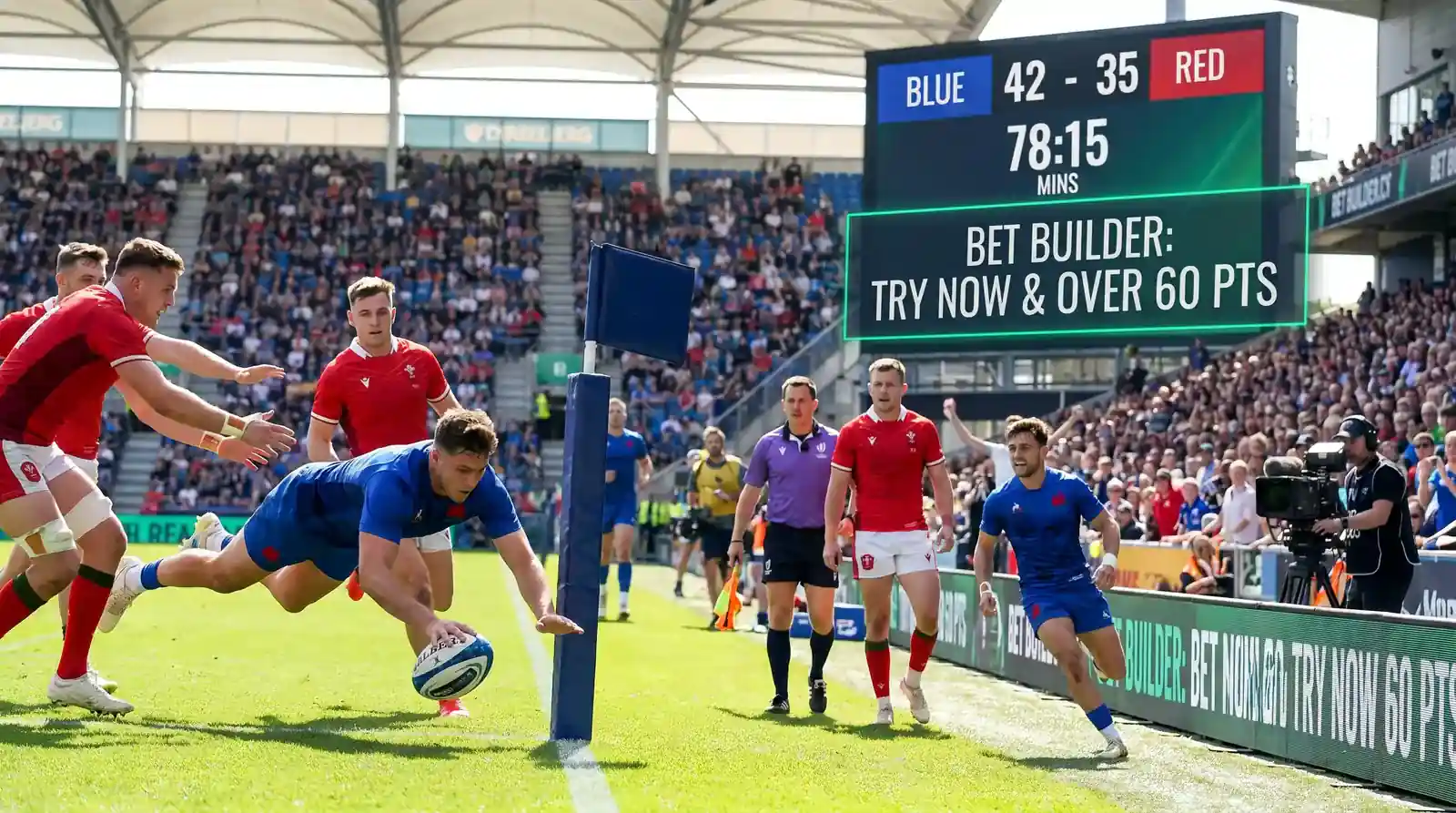
The best entry points in live rugby follow a consistent pattern. The first is immediately after a score that shifts the narrative. When the underdog takes the lead or the favourite falls further behind, the in-play model adjusts to the new scoreline — but human bettors who are watching the match and reading the underlying performance can often see that the scoreline is misleading. A team that has conceded a try against the run of play does not become a worse team in the next five minutes, but the model treats them as though they have. That post-score window, typically 60-90 seconds, is when mispricing is most common.
The second entry point is the ten minutes after half-time. Coaches make tactical adjustments during the break, and those adjustments manifest in the first ten minutes of the second half. A team that was struggling in the first half may come out with a different game plan — wider passing, more kicking, a changed lineout caller — and the in-play model cannot anticipate coaching interventions. If you watch the first five minutes of the second half and see a visible tactical shift, bet before the model catches up.
 The 2025 Six Nations averaged 55 points per match, and a significant share of that scoring came in the 40-55 minute window when half-time changes were still fresh and defensive systems had not yet recalibrated.
The worst time to enter is during a sustained period of dominance by one team. If the attacking side has been camped on the opposition line for five minutes and the odds have been shortening continuously, you are buying at the top. The likely outcomes at that point are a try (which is already priced in) or a turnover (which will cause the odds to swing sharply the other way). Wait for the resolution of the attacking phase before placing your bet. Patience is the most undervalued skill in live betting.
One timing rule I follow without exception: never bet in-play during the final five minutes of a match unless I am hedging an existing position. The final minutes of rugby are chaotic — teams trailing throw caution to the wind, discipline collapses, penalties and sin-bins spike. The model churns through rapid odds changes, and the probability of placing a bet at a price that accurately reflects the remaining outcome is low. Better to sit on your hands and let the match finish than to chase a last-minute position.
Managing Risk in Fast-Moving In-Play Markets
The rush of live betting is precisely what makes it dangerous. I know from experience. My worst single loss in rugby betting came from an in-play session where I chased a bad bet with a worse one, doubling my exposure at progressively shorter odds until the match ended and I had turned a manageable loss into an ugly one. The lesson was expensive but permanent: in-play betting requires tighter risk controls than pre-match betting, not looser ones.
The first rule is a session limit. Before the match kicks off, I decide the maximum I am willing to stake across all in-play bets during that fixture. That limit is separate from my pre-match stakes. If I hit the limit, I stop — even if I see what looks like an obvious opportunity in the 70th minute. The most successful in-play bettors I know all use some version of this rule. The ones who do not tend to have spectacular weeks followed by devastating ones.

The second rule is never to bet in-play for the purpose of recovering a pre-match loss. If your pre-match handicap bet is losing at half-time, the temptation to place a live bet that hedges or recovers is strong. Resist it. That live bet is being placed from a position of emotional pressure rather than analytical insight, and the bookmaker’s in-play margin means you are paying a premium for the privilege of chasing your losses. Problem gambling affects 2.7% of UK adults at the level of 8 or more on the PGSI scale, with the 18-24 age group most vulnerable at roughly 10%. The speed and accessibility of in-play markets increase the risk of impulsive betting for anyone, not just those already in difficulty.
The integrity professionals who monitor global sport for suspicious betting patterns talk constantly about sustained vigilance — the idea that discipline over time matters more than any single intervention. The same principle applies to your own betting behaviour. One profitable live bet does not make you an in-play expert. One bad session does not make you a problem gambler. What matters is the system you maintain over time — session limits, honest record-keeping and the willingness to sit out a match entirely when the in-play markets offer nothing worth taking.
Where to Watch Rugby Live for Betting in the UK
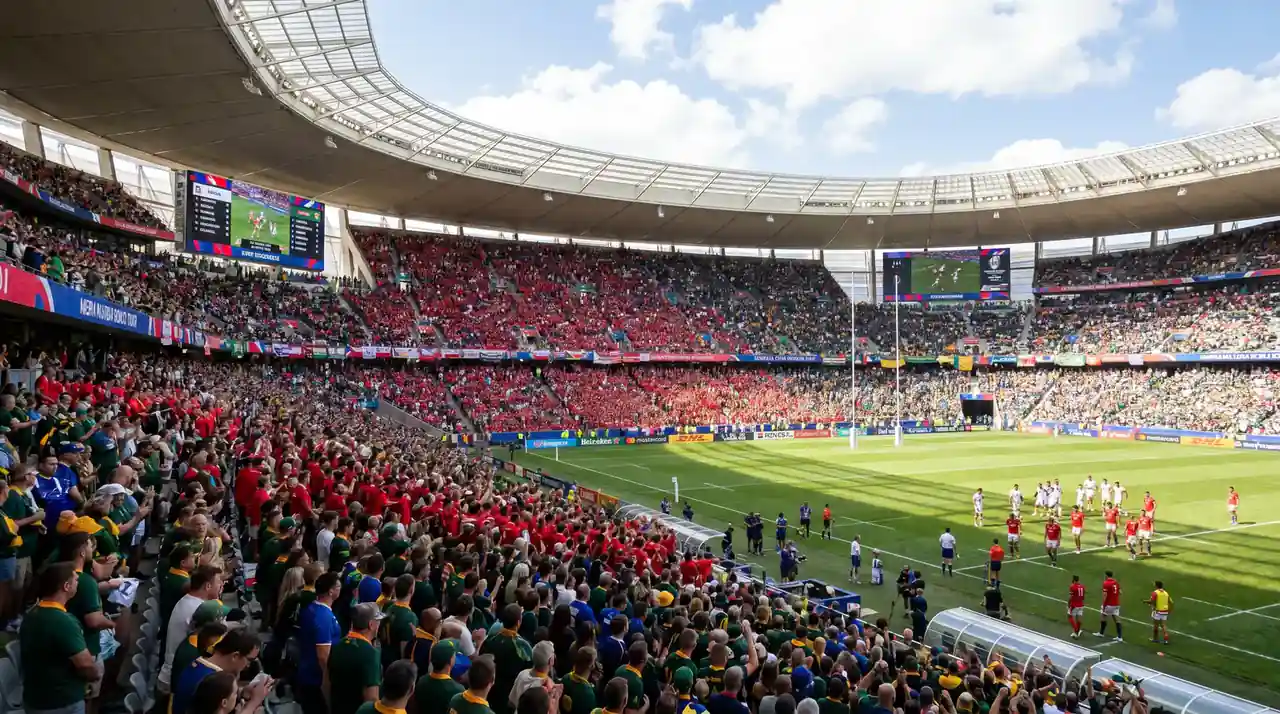
You cannot bet effectively in-play without watching the match. Stats feeds and score updates are too slow and too thin — they tell you what happened but not how the game feels. For UK-based bettors, the broadcast landscape provides solid coverage across both codes.
The Six Nations 2026-2029 broadcast deal splits coverage between ITV and BBC. ITV holds all England fixtures and the majority of matches, while BBC covers Scotland and Wales home games. Both are free-to-air, which is a significant advantage over club rugby where pay-TV or streaming subscriptions are often required. The fact that the Six Nations was streamed nearly 15 million times on ITVX in 2026 shows the scale of the digital audience — and for in-play bettors, streaming on ITVX via a phone or tablet while placing bets on the same device is the most seamless setup available.
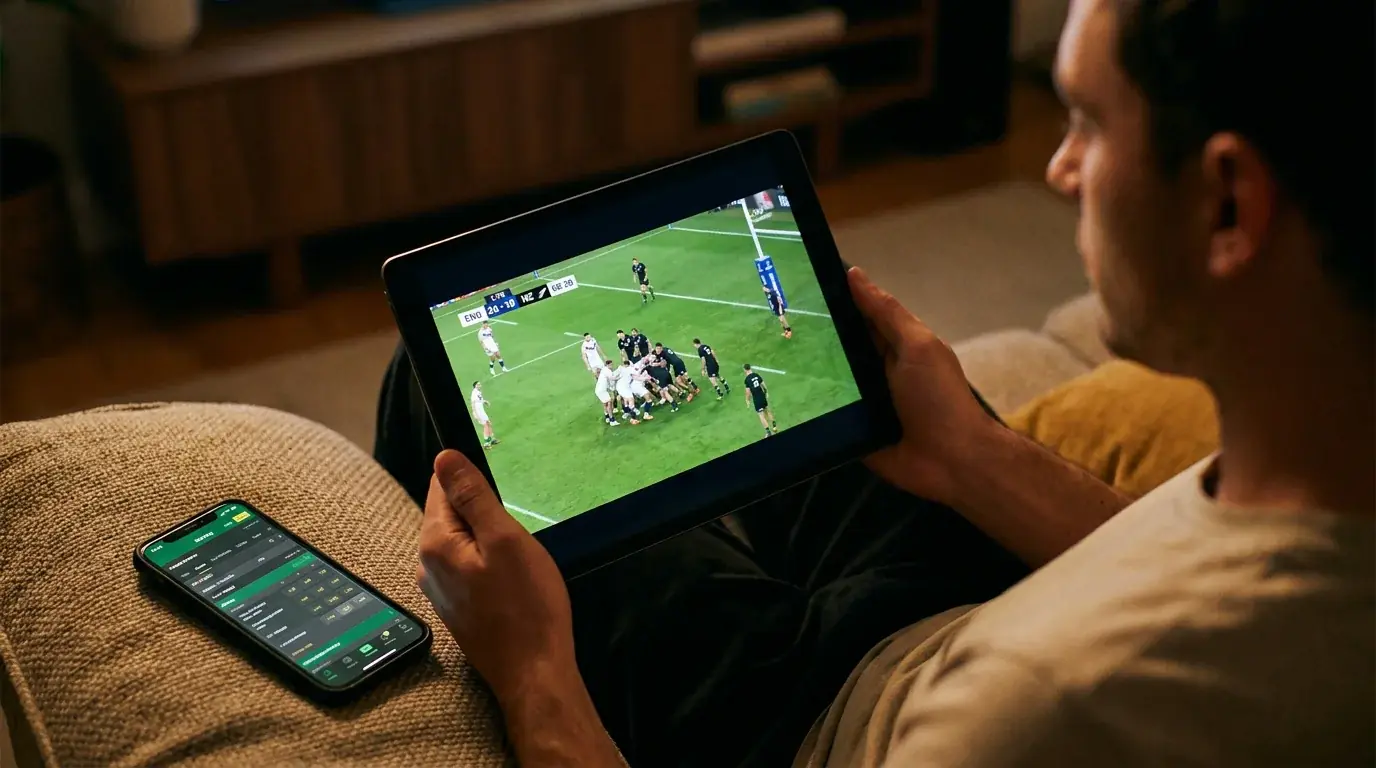
Premiership Rugby is available on TNT Sports (formerly BT Sport), with selected matches also appearing on free-to-air channels. Super League is broadcast on Sky Sports, with some fixtures on free-to-air via the BBC. NRL coverage in the UK is available through Sky Sports, though the time-zone difference means most matches air in the early hours. Several bookmakers offer in-app live streaming of rugby matches on which they have coverage rights — check whether your chosen operator provides this before match day, because the availability of in-app streams varies by fixture and by competition.
The gap between watching the match and reading the scoreboard is the gap between informed live betting and guesswork. Build your in-play approach around fixtures you can actually watch, and leave the ones you cannot see to the pre-match markets.
Frequently Asked Questions
How quickly do in-play rugby odds react to a try being scored?
In-play odds typically adjust within 5-10 seconds of a try being confirmed. During TMO reviews, most operators suspend the market entirely — no bets are accepted until the decision is announced. Once confirmed, the market reopens with odds reflecting the new scoreline. The window for exploiting post-try mispricing is narrow but real, particularly when the try does not change the underlying momentum of the match — for example, a breakaway try scored against the run of play that shifts the odds more than the actual game state warrants.
Is live rugby betting available for lower-tier domestic matches?
In-play markets for lower-tier fixtures — such as mid-table Championship or League 1 matches — are limited or nonexistent at most UK bookmakers. Operators typically offer live betting only on matches with live data feeds and broadcast coverage, which restricts in-play options to top-tier competitions: Premiership, Super League, Six Nations, Champions Cup, NRL and major internationals. If a fixture is not televised or streamed, the likelihood of in-play markets being available is low.
What is the safest in-play market for rugby beginners?
The next-scoring-method market is a good starting point for beginners. It asks a simple question — will the next score be a try, penalty goal, conversion or drop goal — and the options are limited enough that the probability assessment is manageable. Penalty goals are undervalued in this market when a match is tight and teams are camped in each other’s halves trading penalties. Beginners should avoid in-play handicap and totals bets until they are comfortable reading momentum shifts in real time.
Written by the editors at Rugby Betting Tips.