Rugby Betting Beginners Guide: From First Bet to First Strategy
 Available in US

Everything You Need to Know Before Placing Your First Rugby Bet
Nine years ago, I placed my first rugby bet. It was a match-winner on a Six Nations fixture, and I chose my side based entirely on which team I wanted to win. I did not check the odds, I did not compare bookmakers, and I did not consider whether the price represented value. I won that bet through luck, not skill, and spent the next two years learning how little I actually understood about what I had done. This guide is the one I wish I had read before that first bet.

Rugby betting in the UK is straightforward to access — roughly 10% of the adult population actively participates in online sports betting, and rugby markets are available at every major licensed operator. But accessibility and understanding are different things. Placing a bet takes thirty seconds. Placing a bet that has a positive long-term expectation requires knowledge of how odds work, how bookmakers set their margins, and how to evaluate whether a price is fair. This guide gives you that foundation without assuming any prior experience.
Setting Up a Betting Account: What to Look For
The first practical step is opening an account with a UKGC-licensed bookmaker. The Betting and Gaming Council represents approximately 90% of the UK’s betting and gaming industry outside lotteries, and its members all operate under Gambling Commission licence conditions. That licence is your baseline assurance that the operator is regulated, your funds are protected, and the platform meets minimum standards for fairness and responsible gambling.

When you register, you will be asked for proof of identity and address. This is a legal requirement under anti-money-laundering regulations, not an optional step. The process typically takes a few minutes if you upload documents digitally. Once verified, you can deposit funds and access the full range of markets.
Before you deposit anything, set a deposit limit. Every UKGC-licensed operator must offer this feature. Choose a monthly limit that reflects what you can comfortably afford to lose entirely. If you are starting out, I recommend a modest amount — enough to place 20 to 30 bets at small stakes over a couple of months. That gives you a meaningful learning sample without financial risk that could cause stress.
Look at the operator’s rugby market coverage before committing. Open a live Premiership or Six Nations fixture and count the available markets. If the operator offers fewer than 20 markets per match, their rugby product is thin and you may find better value elsewhere. Also check whether the operator offers a bet builder, live streaming and cash-out functionality — these are features you may not use immediately but will want as your experience grows.
Placing Your First Bet: A Step-by-Step Walkthrough
Your first bet should be simple: a match-winner on a fixture you intend to watch. Watching the match gives you a connection between your analysis and the outcome, and it is the fastest way to learn how rugby betting works in practice.

Navigate to the rugby section of the bookmaker’s site. Find the match you want to bet on. You will see the match-winner market displayed with odds for each side. If it is a Union match, there may be a draw option; if it is a League match, draws are less common and some markets exclude them. Click on the selection you want to back. It will appear in your bet slip.
Enter your stake — the amount you want to wager. The bet slip will display the potential return: your stake multiplied by the decimal odds. At decimal odds of 1.80 and a five-pound stake, your potential return is nine pounds (five pounds stake plus four pounds profit). Confirm the bet. That is it.
Now, here is the part that most beginners guides skip: understanding what just happened. You bought a probability at a price. The bookmaker’s odds of 1.80 imply a probability of approximately 55.6%. If you believe the true probability is higher than 55.6%, you have made a value bet. If you believe the true probability is lower, you have overpaid. Your first bet is probably based on instinct rather than calculation, and that is fine — but from bet two onward, start thinking about whether the price is fair, not just whether you think the team will win.
One point on bet settlement: rugby bets on match-winner markets are typically settled on the result at full time (80 minutes). Extra time is excluded unless the market explicitly states otherwise. If the match ends in a draw and you backed a side to win, your bet loses. If the draw was not offered as an option, your stake is usually returned — but check the specific rules on the operator’s site.
Five Mistakes Every New Rugby Bettor Makes
I made all five of these mistakes in my first year of betting. Listing them is not about condescension — it is about saving you the time and money I spent learning the hard way.

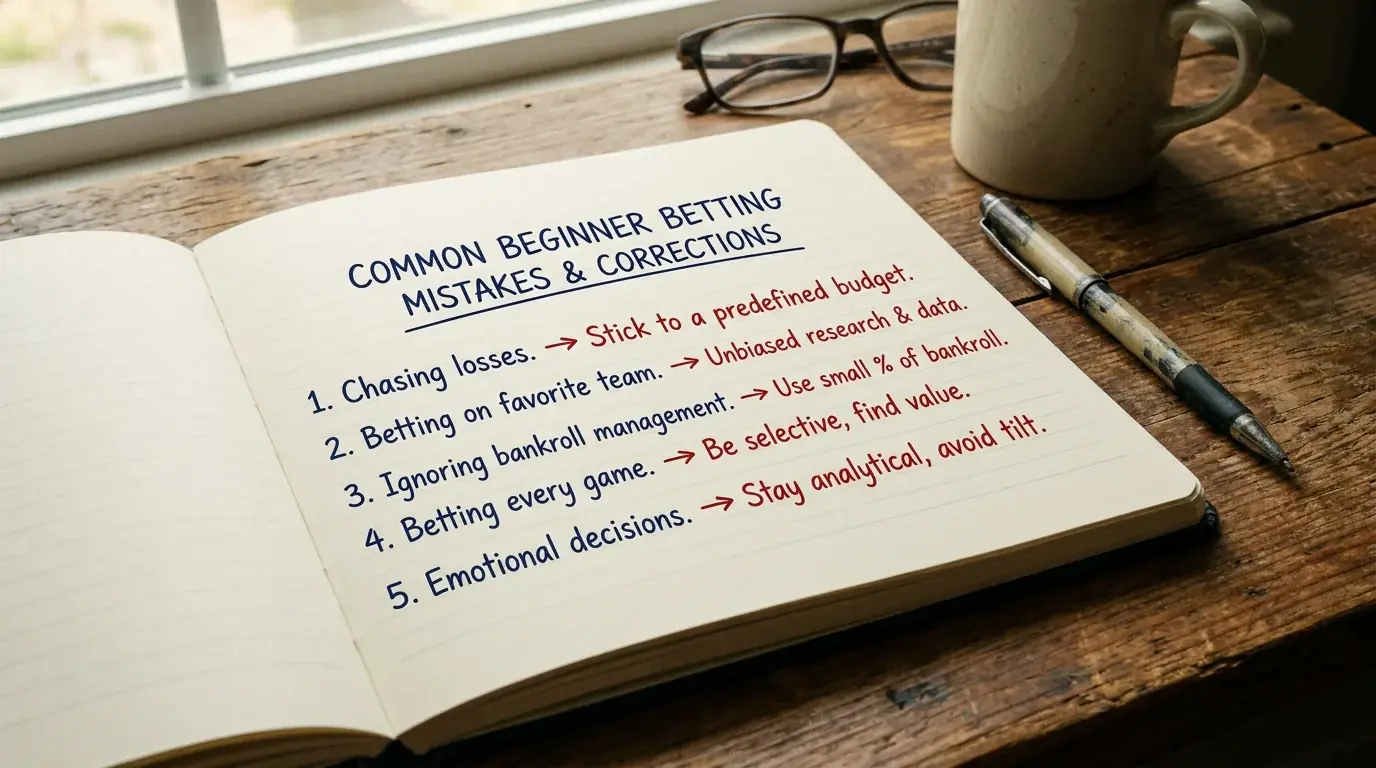
The first mistake is betting on every match. A full round of Premiership fixtures offers nine matches, and the temptation is to have a bet on each one. Resist it. Your edge, if it exists at all as a beginner, is narrow. Betting on matches where you have no informed view dilutes your profitable bets with random ones. I now bet on roughly one-third of available rugby fixtures — the ones where my analysis identifies a specific edge.
The second mistake is chasing losses. You lose three bets in a row and increase your fourth stake to win back the deficit. This is the fastest route to blowing a bankroll, and it is driven by emotion, not logic. Among UK adults, 2.7% are classified as problem gamblers on the PGSI scale, and chasing losses is one of the key behaviours that screening tool identifies. Set a staking plan and follow it regardless of recent results.
The third mistake is ignoring the bookmaker’s margin. New bettors compare two sides’ odds and pick the one they think will win, without considering that both prices include a margin that tilts the long-run expectation against them. Understanding the overround — the total implied probability across all outcomes in a market — is essential. If the overround is 108%, the bookmaker takes 8% of every pound wagered in that market, on average, over time.
The fourth mistake is betting on accumulators too early. Accumulators are exciting because the combined odds look large, but the margin on each leg compounds. A four-leg acca with 5% margin per leg carries a cumulative margin above 20%. As a beginner, stick to single bets until your strike rate and analysis are consistent enough to absorb the margin drag that accumulators impose.
The fifth mistake is neglecting rugby handicap betting. New bettors default to match-winner markets because they are intuitive. But handicap markets often offer better value because they require the bettor to assess not just who wins but by how much. That additional dimension rewards analysis and reduces the bookmaker’s information advantage. Learning to read handicap lines early in your betting journey will pay dividends for years.
What is the minimum bet for rugby at most UK bookmakers?
Most UK-licensed bookmakers set a minimum stake of between five pence and one pound for online rugby bets, though the exact amount varies by operator and sometimes by market. In practice, you can begin with very small stakes while learning. Starting with the minimum and increasing only as your understanding and confidence grow is a sound approach.
Should beginners start with match-winner bets or handicaps?
Match-winner bets are the simplest starting point because the outcome is binary — your side wins or it does not. However, handicap markets often offer better value because they require a more nuanced assessment of the likely margin. A practical approach is to place your first five to ten bets on match-winner markets to learn the mechanics, then transition to handicaps as you develop your analytical skills.
Created by the ”Rugby Betting Tips” editorial team.