Rugby Form Guide for Betting: Separating Signal from Noise in Recent Results
 Available in US

A Winning Streak Does Not Mean What Most Bettors Think It Means
Last season, a Premiership side won five consecutive matches by increasingly narrow margins. The bookmaker’s line shortened with each win, treating the side as though they were improving. I went the other way. The narrowing margins told me they were over-performing relative to their underlying quality — winning close games that could have gone either way. By the sixth match, they were priced as heavy favourites. They lost by 14 points.
That anecdote captures the central problem with form guides in rugby betting: raw results are a terrible indicator of future performance unless you know how to read them. A five-match winning streak can mask declining form just as easily as a three-match losing run can hide genuine improvement. The bettors who profit from form analysis are not the ones who count wins and losses — they are the ones who look beneath the scoreline to understand why those results happened and whether the underlying drivers are sustainable.
What a Rugby Form Guide Should Actually Contain
I have built and refined my own rugby form model over nine seasons, and it bears no resemblance to the simple W-L-D tables that most websites publish. A useful form guide for betting purposes needs five components: results, margins, venue context, opponent quality and performance metrics that go beyond the scoreline.
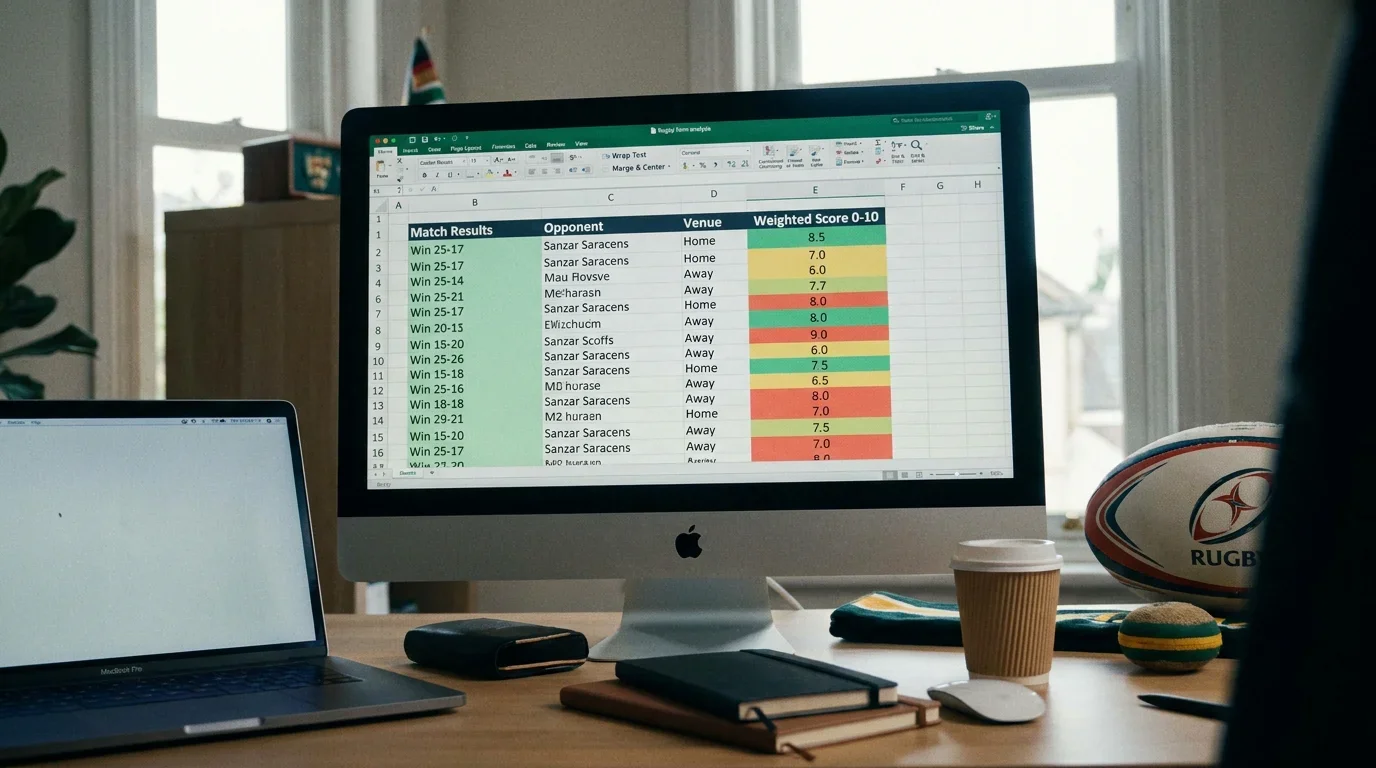
Results are the starting point but never the endpoint. I record the last six to eight matches for each side, including the competition, the venue and whether the match fell during a period of squad disruption (international windows, injury crises, end-of-season rotation). A win is not just a win — it is a win at home against a bottom-four side during a period of full-strength selection, or it is a win away against a top-four side with three first-choice players unavailable. Those are radically different data points that a simple W or L collapses into the same symbol.
Margins tell you about dominance or fragility. A side winning by 20+ points is performing differently from a side winning by 3. I track not just the final margin but the margin at half-time and the trajectory within the match. A side that led 21-0 at half-time and won 24-17 has a very different second-half profile from a side that trailed 10-14 at the break and won 28-14. Sportradar monitors over 1,000,000 sporting events globally, and their data increasingly supports what margin analysis has shown me for years: second-half performance is a more stable predictor of future results than first-half performance.
Opponent quality is the adjustment that separates serious form analysis from casual observation. Beating a side that sits last in the table is not the same as beating the table leader. I weight each result by the opponent’s current league position or world ranking, so that a narrow loss to the best side in the competition counts as more positive form signal than a comfortable win over the weakest.
The Recency Window That Balances Relevance and Sample Size
How far back should you look? This question trips up more bettors than any other aspect of form analysis. Look too far back and you include data from a different phase of the season, with different squad compositions and tactical approaches. Look too recently and your sample is too small to distinguish signal from noise.
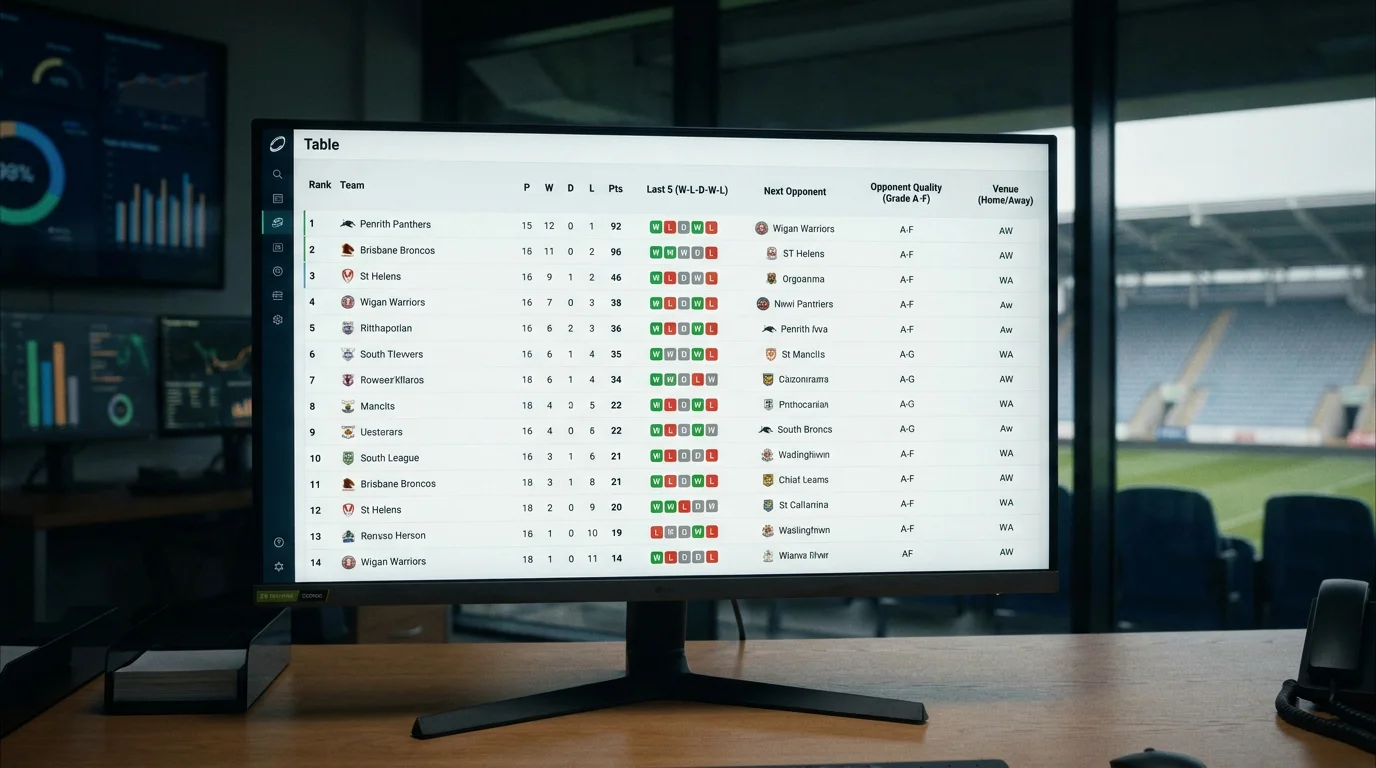
My default window is six matches for club rugby and four matches for international rugby. Six club matches typically cover three to four weeks of fixtures — enough to capture current tactical identity and squad fitness without dragging in data from a period when the side was operating under different conditions. Four international matches covers one complete tournament window or two separate test series, which is the minimum needed to assess a national side’s current form.
I adjust the window based on context. If a side has had a coaching change within the last six matches, I weight the post-change matches more heavily and treat the pre-change data as background rather than signal. If a side has returned from an international window with a different squad composition, I reset the form guide to begin from their first post-window fixture. The point is that “form” is not a fixed historical record — it is a moving picture that needs constant reframing.
The one trap I see constantly is recency bias taken to an extreme: bettors who base their entire assessment on the most recent match. One match is noise. A single result tells you almost nothing about a side’s true quality, because the variance within rugby is enormous. A bounce of the ball, a referee’s interpretation, a yellow card at a critical moment — any of these can swing a match by 10 or more points without reflecting any underlying shift in form. When I see a bookmaker’s line move significantly after a single unexpected result, I treat it as an opportunity rather than a signal, because the market is overreacting to noise.
Integrating Form with Pre-Match Variables
Form analysis in isolation is insufficient. The form guide gives you a baseline assessment of each side’s current quality, but the pre-match variables — venue, weather, team news, motivation — modify that baseline for each specific fixture.


Venue is the most significant modifier. Home advantage in the Premiership is worth approximately 3-5 points on the handicap line, and that advantage is stable across seasons. A side showing strong away form is a more impressive signal than strong home form, because away performance strips out the venue advantage and gives you a cleaner read on underlying quality. I flag any side whose recent form includes three or more away wins as potentially underrated by the market, because bookmakers anchor to overall records more than venue-specific records.
Team news interacts with form in ways that require careful judgment. A side on a winning run that loses its first-choice fly-half to injury is not the same side that generated those wins. The form guide data still reflects the previous squad composition, and the market may not fully adjust for the personnel change. Conversely, a side on a losing run that gets a key player back from injury may be about to reverse its trajectory — and that reversal is not visible in the form data because the player was absent during the period the data covers.
Weather deserves special attention during the UK winter months, when conditions vary dramatically between fixtures. A side’s recent form compiled on dry pitches is not transferable to a rain-affected match without adjustment. I maintain separate form metrics for wet-weather and dry-weather performance, and the differences for some sides are striking. A team that attacks with width in dry conditions but struggles in the rain will show inconsistent form in mixed-weather periods, but the inconsistency is not random — it is predictable once you separate the data by conditions. For a full treatment of how conditions alter match dynamics, weather impact on rugby betting breaks down the numbers.
When Form Guides Fail and What to Use Instead
Form guides are least reliable at three points in the calendar: the start of a new season, immediately after international windows, and during end-of-season dead rubbers.

The start of a new season is self-evident — there is no recent form to analyse. Pre-season results are meaningless for betting purposes because sides use them for experimentation and fitness-building rather than competitive outcomes. I spend the first three to four rounds of each Premiership season gathering data rather than betting heavily, because the form picture has not yet developed. UK bookmakers collectively process around 290 million online sports bets per month, and early-season lines are set primarily on pre-season assessments and previous-season data rather than current form — which means they are less accurate and the market is less efficient. That inefficiency cuts both ways: there is value to find, but also more noise to navigate.
Post-international windows disrupt form for club sides because key players return fatigued, sometimes carrying minor injuries that do not make the official team news. A club side resuming Premiership action after a November international window is operating at diminished capacity relative to their pre-window form, and the extent of the disruption depends on how many players were involved in tests and how demanding those tests were.
End-of-season dead rubbers are fixtures where one or both sides have nothing to play for. Motivation drops, coaches rotate squads, and the results bear no resemblance to mid-season competitive form. I exclude dead rubbers from my form calculations entirely and suggest you do the same.
How many matches should a rugby form guide cover?
Six matches is the default window for club rugby and four for international rugby. This balances recency with sample size. Adjust the window if there has been a coaching change, a significant injury to a key player, or a break in the competitive calendar. The goal is to capture the side’s current tactical identity and squad composition without including data from a period when those factors were materially different.
Does home or away form matter more for betting?
Away form is a stronger signal of underlying quality because it removes the home-advantage effect, which is worth approximately 3-5 points on a handicap line in the Premiership. A side showing strong away results is more likely to be genuinely in form than a side whose wins have all come at home. Compare both, but weight away performance more heavily when assessing true quality.
Published by the Rugby Betting Tips team.