Weather Impact on Rugby Betting: Rain, Wind and Cold in the Numbers
 Available in US
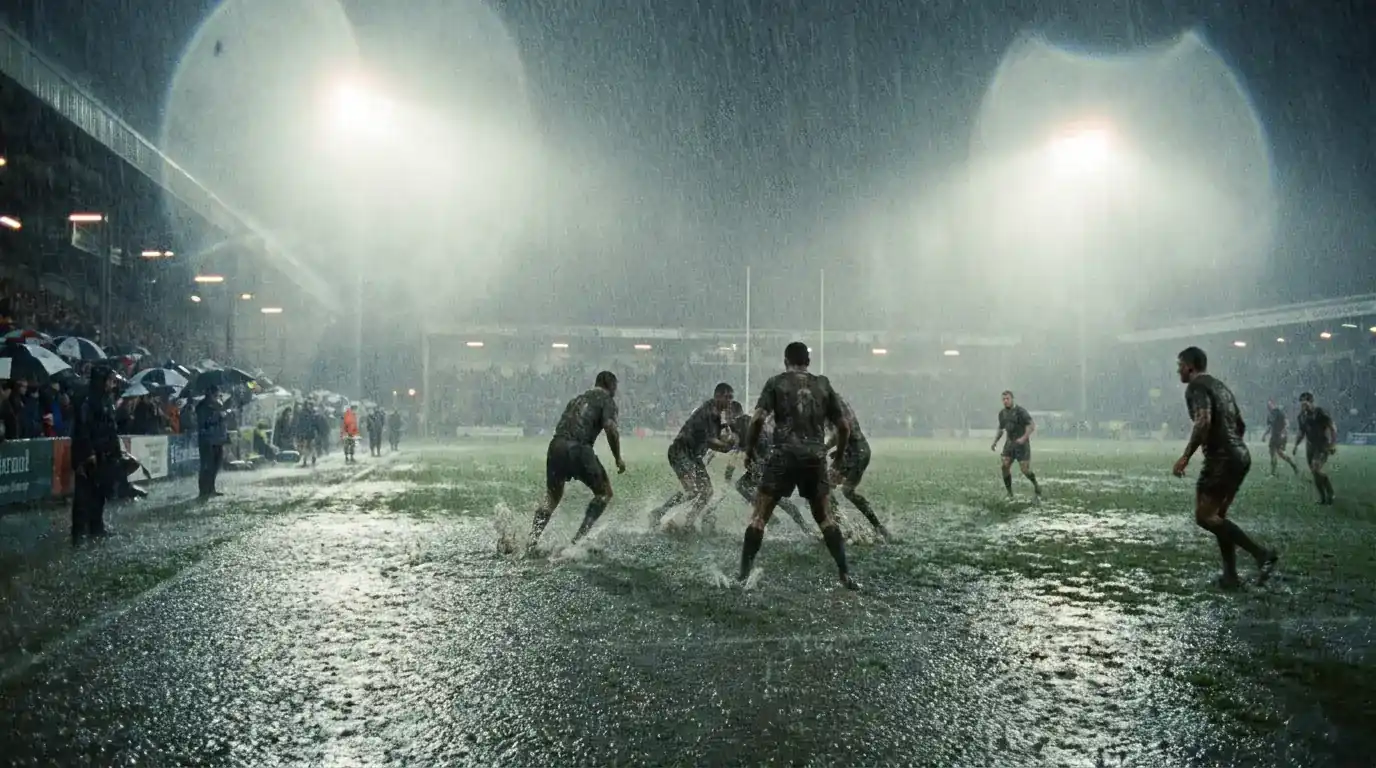
UK Weather Is Not Just Small Talk — It Moves Betting Lines
January 2023. A Premiership fixture in the West Country. Persistent rain from Thursday through Saturday turned the pitch into something closer to a ploughed field. The bookmaker’s totals line sat at 46.5, anchored to both teams’ season averages. The final combined score was 19. I had taken the under at 1.90 based entirely on the weather forecast. That single bet crystallised a principle I have relied on ever since: weather is the most underpriced variable in rugby betting, because bookmakers set lines on historical scoring data and adjust for conditions only partially.
Rugby is an outdoor winter sport played predominantly in the UK between September and June. Rain, wind and cold are not occasional disruptions — they are the default operating environment for roughly half the domestic season. Any bettor who ignores weather is ignoring a factor that can shift total points by 10 or more in a single match. The Six Nations 2025, played across February and March, averaged 55 points per match — but that average masks enormous fixture-by-fixture variation driven partly by conditions on the day.
Rain: Handling Errors, Scrums and Lower Totals
Rain is the most impactful weather variable in rugby because it affects the fundamental mechanics of the game. A wet ball is harder to catch, harder to pass accurately, and harder to control at the breakdown. Handling errors increase, turnovers increase, and the proportion of play spent in scrums and set pieces rises. All of this suppresses scoring.


I have tracked Premiership matches played in continuous rain over the last five seasons and found that total points drop by an average of 8 to 12 points compared to dry-condition matches between the same quality of opposition. That is a massive effect — large enough to swing a totals line from over to under in most fixtures. In particularly heavy rain, the effect is even more pronounced. Matches played in storm conditions regularly produce totals below 30, even between sides that average 45 or more in dry weather.
The mechanism is not just handling errors. Rain changes tactical behaviour. Coaches instruct their sides to kick more, take fewer risks in their own half, and rely on set-piece dominance rather than multi-phase attack. The game becomes territorial — teams trade kicks, compete at the lineout and scrum, and try to score from close-range drives or penalty goals rather than expansive tries. Fewer tries mean fewer conversions, and the compounding effect drags the total down further.
For bettors, the actionable insight is straightforward: check the match-day weather forecast before placing any totals or handicap bet. If persistent rain is expected, compare the bookmaker’s line to the historical scoring average in wet conditions, not the overall season average. The discrepancy between those two numbers is where the edge sits. If you are building a systematic approach to pre-match analysis, the rugby form guide for betting covers how to integrate weather alongside other predictive variables.
Wind: Conversion Rates, Penalty Goals and Territory
Wind is subtler than rain but no less important, particularly in matches where goal-kicking accounts for a large share of total points. A strong crosswind or swirling wind at an open stadium reduces conversion accuracy and penalty-goal success rates. Fly-halves and fullbacks who are reliable 85% goal-kickers in calm conditions can drop below 70% when the wind is unpredictable.

The impact on totals depends on the match profile. In a fixture where both sides are expected to compete through penalties and conversions rather than a free-flowing try-fest, wind can suppress the total significantly. If the bookmaker’s line assumes a 75% kicking success rate and the actual success rate drops to 60% because of wind, the expected points contribution from goal-kicking alone falls by three to five points. In a tight Six Nations match where 15 of the projected total comes from kicks at goal, that is a meaningful shift.
Territory is the other wind-driven factor. A strong wind at a ground with open ends gives the side playing with the wind a territorial advantage in one half and a disadvantage in the other. This creates an asymmetric scoring pattern — teams score more heavily with the wind and struggle against it. That pattern affects half-time/full-time markets, first-half handicaps, and live betting odds during the match. If you know the wind direction and which side is kicking which way in each half, you can anticipate shifts in live odds that less-informed bettors will not see coming.
I pay particular attention to wind at grounds that are exposed or elevated. Coastal and hilltop stadiums in Wales, Scotland and the north of England are the worst for wind disruption. Enclosed stadiums or those with full roofing — like the Principality Stadium with its retractable roof — neutralise the wind factor entirely when the roof is closed. Knowing which venues are wind-vulnerable and which are sheltered is a small piece of structural knowledge that compounds over a full season of betting.
Timing Your Weather Check Before Placing a Bet
The value of weather information is time-sensitive. Bookmakers do incorporate weather into their line-setting, but they do so imperfectly and with a lag. Lines are typically set 48 to 72 hours before kick-off, based on prevailing forecasts at that point. Weather forecasts become significantly more accurate inside the 24-hour window before the match, and conditions can change materially in the final hours.

My process is specific. I note the opening totals line and handicap when they are published — usually Tuesday or Wednesday for a Saturday fixture. I then check the weather forecast on Friday evening and again on Saturday morning, three to four hours before kick-off. If the forecast has shifted meaningfully — from dry to rain, from calm to strong wind — and the bookmaker’s line has not adjusted by a corresponding amount, I have a bet.
UK bookmakers collectively process around 290 million online sports bets per month. The volume means that lines on high-profile fixtures adjust quickly in response to money, including weather-driven money. But for lower-profile domestic fixtures — Premiership matches outside the television schedule, Challenge Cup ties, Championship fixtures — the market is thinner and adjustments are slower. Those are the matches where weather-driven value is most likely to persist until close to kick-off.
One practical tip: do not rely on a single weather source. I cross-reference two forecasts — one general and one hyperlocal — and look for agreement. If both sources predict continuous rain, I treat it as near-certain. If one predicts rain and the other does not, I am more cautious. The cost of a wrong weather call is a bet placed on a false premise, and that is a cost I prefer to avoid.
Cold, Frost and the Margins That Nobody Tracks
Rain and wind get the attention, but cold deserves a mention because it affects kicking accuracy and soft-tissue injury risk in ways that occasionally produce unexpected results. Sub-zero temperatures make the ball harder and less forgiving. Spiral kicks and place kicks behave differently in freezing conditions, and goal-kicking accuracy can dip without an obvious explanation visible from the stands or the broadcast.

Cold also increases the risk of early injuries, particularly muscle strains. A key player leaving the field inside the first twenty minutes due to a hamstring injury sustained in freezing conditions changes the match in ways that no pre-match model captures. I do not build cold into my model as a primary variable, but I note it as a caution flag — a reason to reduce stake size rather than avoid the market entirely. In a sport where the margin between a good bet and a break-even bet is often 2-3%, even marginal factors deserve acknowledgement.
How much does heavy rain typically reduce total points in a rugby match?
Based on five seasons of Premiership data, persistent rain reduces combined scoring by an average of 8 to 12 points compared to dry conditions. In extreme storm conditions, the reduction can be larger, with totals frequently falling below 30 even between sides that average in the mid-40s in dry weather. The effect is driven by increased handling errors, more scrums and a shift to territorial kicking.
Where can I find reliable match-day weather forecasts for UK rugby grounds?
General forecasting services provide good coverage, but hyperlocal forecasts — those that give hourly predictions for a specific postcode or location — are more useful for match-day decisions. Cross-referencing two independent sources reduces the risk of acting on an inaccurate forecast. Check the forecast on the morning of the match, three to four hours before kick-off, for the most accurate reading.
Published by the Rugby Betting Tips team.