Value Betting in Rugby: Finding Positive Expected Value in Every Market
 Available in US

Winning Bettors Do Not Pick the Most Winners — They Find the Most Value
There is a bettor I have followed for years whose public record shows a strike rate of 43%. Fewer than half his bets win. And yet, over five years, his return on investment sits above 8%. How? Because his average winning bet pays significantly more than the average losing bet costs. He does not pick winners — he finds mispriced odds. That distinction is the most important concept in professional sports betting, and it is the foundation of everything I do as a rugby analyst.
Value betting means placing bets where the odds offered by the bookmaker imply a lower probability than your own assessment of the true probability. If you believe a side has a 50% chance of covering the handicap and the bookmaker’s odds imply only a 40% chance, you have found value. The bet might still lose — 50% probability means it loses half the time — but over a hundred similar bets, the return will be positive if your probability estimate is accurate. Sports betting commands a 57.1% share of UK online gambling revenue, and that share is built on the majority of bettors who chase winners rather than value. Positioning yourself on the other side of that equation is where profitability starts.
Expected Value: The Formula Behind Every Smart Bet
Expected value — EV — is the mathematical expression of whether a bet is worth placing. The formula is deceptively simple: EV equals (probability of winning times the profit if you win) minus (probability of losing times the stake lost). If EV is positive, the bet has long-term profitability. If it is negative, you are paying more than the bet is worth.

Let me walk through a concrete rugby example. Suppose you assess that a Premiership side has a 55% chance of covering a -3.5 handicap line. The bookmaker offers 1.91 in decimal odds. Your EV calculation: (0.55 times 0.91) minus (0.45 times 1.00) = 0.5005 minus 0.45 = +0.0505. That is a positive EV of approximately 5% on your stake. Over a hundred bets at this edge, you would expect to profit roughly five units. Not every bet wins, but the portfolio of bets generates a return.
Now consider the same selection at 1.80 odds. EV becomes: (0.55 times 0.80) minus (0.45 times 1.00) = 0.44 minus 0.45 = -0.01. Negative EV. The same selection, the same probability assessment, but a different price turns a value bet into a losing proposition. This is why I say that finding value is about odds, not outcomes. The selection does not change — the price changes everything.
The hard part is the probability estimate. Bookmakers employ teams of traders and algorithms to set odds. Your estimate needs to be more accurate than theirs for a specific match, in a specific market, to generate positive EV. That sounds daunting, but it is achievable in rugby because bookmakers optimise for balanced books across hundreds of markets, while you can specialise in a narrow set of fixtures and market types where your knowledge runs deeper.
Comparing Odds Across Bookmakers to Surface Value
The simplest value-finding technique requires zero modelling skill. Open the same market at three or four bookmakers and compare the odds. The best available price is the closest approximation to true value, because competition between bookmakers compresses margins. If one operator offers 2.10 on a rugby handicap and three others cluster around 1.90, that outlier at 2.10 is either a pricing error, a deliberate loss leader, or a reflection of different opinion. In any case, it is the price you want.
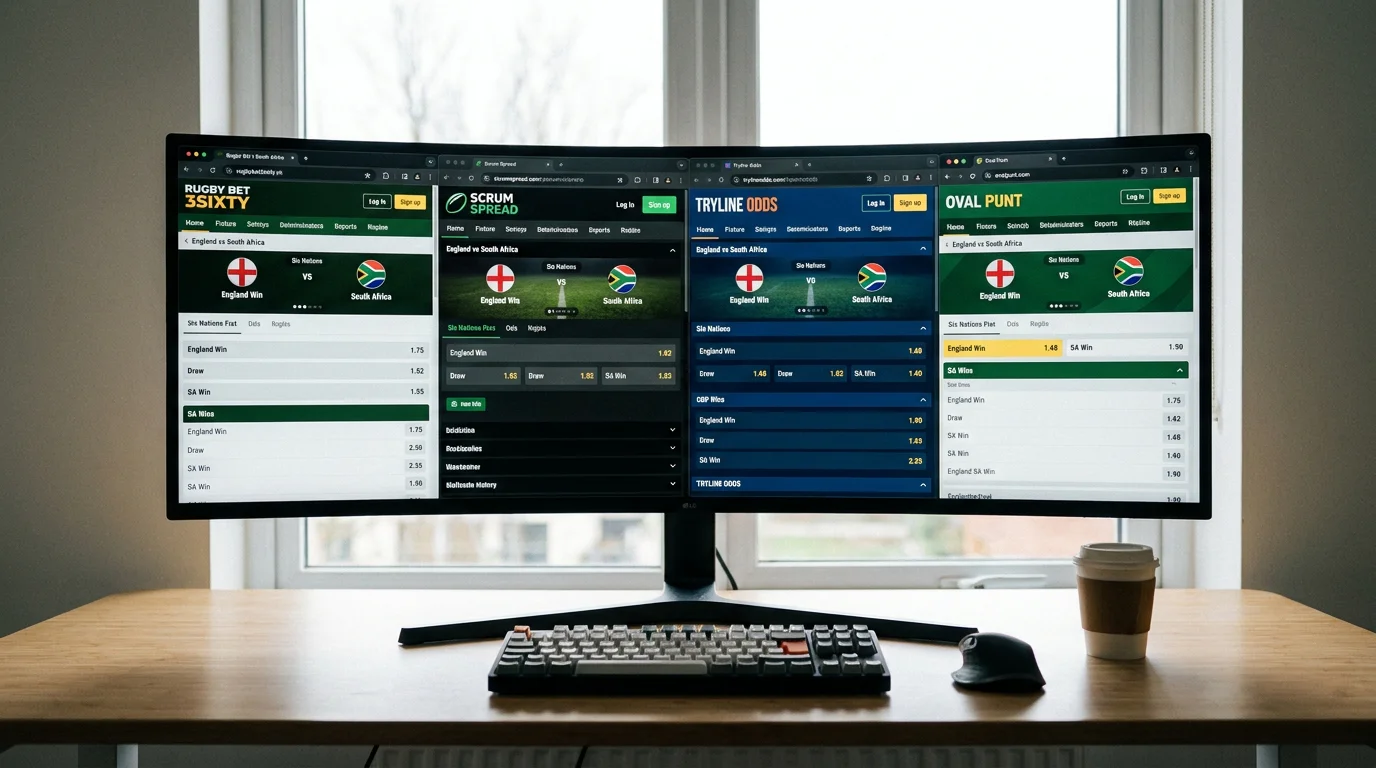
I do this for every bet I place. It takes two to three minutes per fixture and adds an average of 3-5% to my returns over a season. That might sound small, but compounded across 100 or more bets, the cumulative effect is the difference between a break-even year and a profitable one. With UK bookmakers collectively processing around 290 million online bets per month, the sheer volume of pricing means that discrepancies appear frequently — especially on lower-profile domestic fixtures where the market is thinner and individual bookmaker opinion plays a larger role.
Odds comparison tools automate this process, and I recommend using one. But do not rely on them blindly. Some comparison tools include exchanges alongside traditional bookmakers, which can create misleading comparisons because exchange odds do not include commission in the headline number. Always compare like with like: bookmaker to bookmaker or exchange to exchange.
Markets Where Rugby Value Tends to Cluster
Not all rugby markets are equally fertile for value. After nine seasons, I have learned that certain market types consistently produce more mispricing than others, and I concentrate my effort there.


Handicap markets on domestic club rugby are my primary hunting ground. International match-winner markets are efficient because public attention is high, bookmaker resources are focused, and the volume of money forces quick correction. Domestic handicaps, particularly for Premiership and Super League fixtures outside the Saturday television window, receive less attention. Bookmakers set the line, the market does not generate enough volume to force adjustments, and the line can sit wrong until kick-off.
Totals markets in weather-affected fixtures are another reliable source. I covered this in detail in the weather context, but the core point bears repeating: bookmakers set totals lines on scoring averages and adjust for weather only partially. If you can assess the weather impact more accurately than the bookmaker, you will find value in over/under lines on rainy or windy days.
Outright season markets carry value in specific windows — pre-season and mid-season for the Premiership, and 12 to 18 months before a World Cup. These markets move slowly because outright bets lock up punter funds for months, which suppresses volume and delays correction. The Smart Betting Club’s review of one rugby-focused tipping service highlighted a 10.54% ROI from 485 bets across twelve months — and a meaningful portion of that return came from outright and ante-post markets where the prices reflected outdated assessments.
Tryscorer markets, by contrast, are value-hostile for most bettors. The overrounds are extreme — 140% to 180% is typical — and the individual-level variance is enormous. I place tryscorer bets only when I have a specific positional insight that the market has not priced: a tactical change that will favour tries from a certain area of the field, or a player switching to a try-scoring position who is still priced at his old position’s rate. For a broader look at how expected-value logic applies to statistical prediction, expected points models in rugby extends this analytical framework.
The Mindset Shift That Makes Value Betting Work
The hardest part of value betting is not the maths. It is the emotional recalibration. You will back bets that lose. A lot of them. A 55% probability means 45% of your bets are losers, and losing runs of five, six or seven consecutive bets are statistically normal. If you cannot tolerate that without deviating from your process, value betting will not work for you regardless of how sharp your analysis is.

I review my betting record monthly, not daily. Daily reviews create emotional noise — you fixate on the most recent result rather than the aggregate trend. Monthly reviews smooth out the variance and let you assess whether your probability estimates are calibrated. If your estimated probabilities consistently overestimate or underestimate the true outcome rate, you adjust the model. If they are calibrated but the short-term results are negative, you continue — because that is variance, not error, and variance resolves over sample size.
The question I ask myself before every bet is not “will this win?” but “is this price wrong?” Those are fundamentally different questions, and training yourself to ask the second one instead of the first is the mindset shift that separates value bettors from everyone else.
What does positive expected value mean in rugby betting?
Positive expected value means that a bet, if repeated many times at the same odds and probability, would generate a profit over the long run. It occurs when the bookmaker’s odds imply a lower probability of the outcome than your own assessment. A single positive-EV bet can still lose, but a portfolio of positive-EV bets trends toward profit as the sample grows.
How many bookmakers should I compare to find rugby value bets?
Comparing three to four bookmakers per fixture is sufficient for most rugby markets. The goal is to identify the best available price, which typically sits 3-5% above the average across operators. Using an odds comparison tool speeds up the process, but verify that the tool compares bookmaker odds consistently and does not mix in exchange prices without adjusting for commission.
Created by the ”Rugby Betting Tips” editorial team.