Over/Under Rugby Betting: Reading Points Lines and Spotting Mispriced Totals
 Available in US

Total-Points Betting Strips Rugby Down to One Number
I remember sitting in a press box at Twickenham during a Six Nations match where both defences were outstanding, the kicking game dominated, and the final score was 9-6. The total: 15 points. The bookmaker’s line had been set at 44.5. Every over bet was dead before half-time. That afternoon reminded me that total-points betting is not about who wins — it is about understanding the nature of the contest itself.
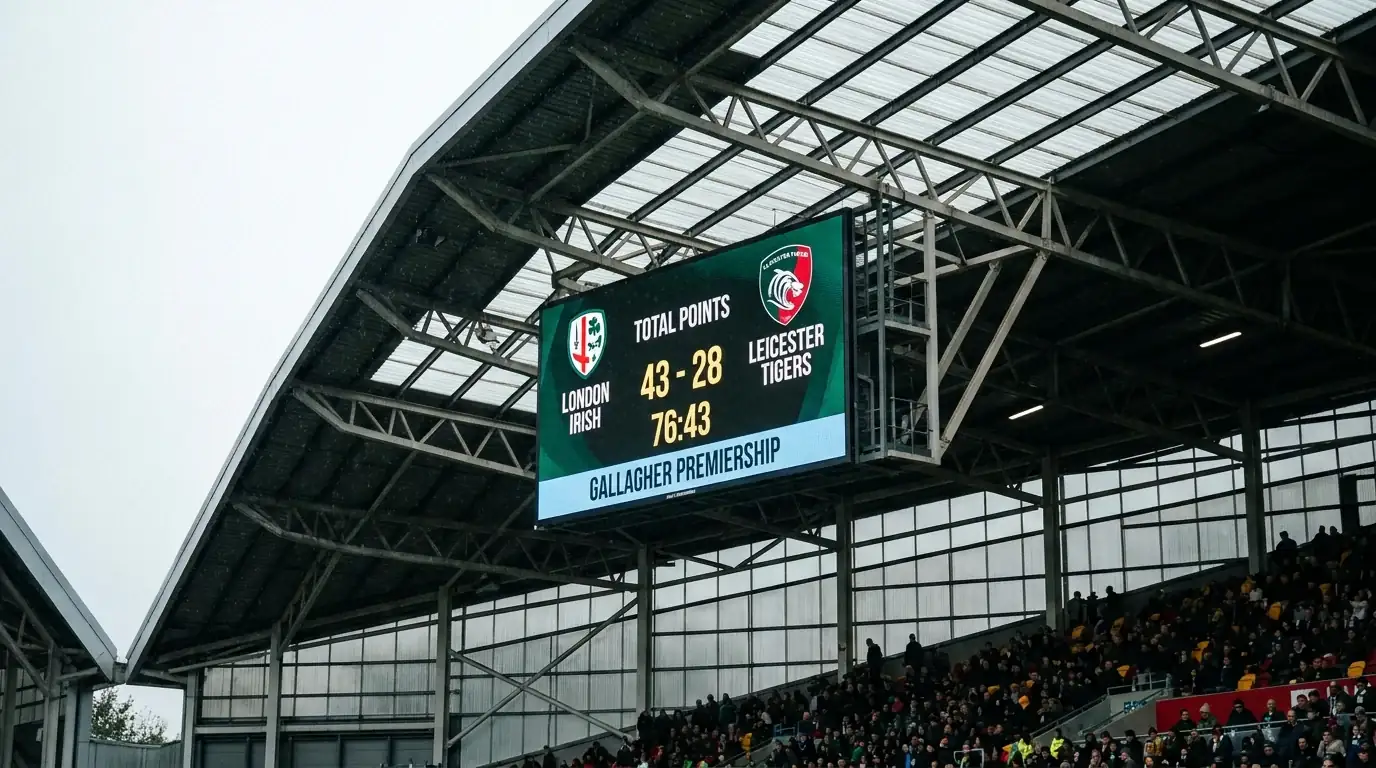
Over/under is one of the cleanest markets in rugby because it strips away the complexity of picking a winner and replaces it with a single question: will the combined points total land above or below a specified line? That clarity attracts bettors who prefer data analysis over gut feel. If you can model scoring patterns, weather effects, and tactical matchups, you can find edges in totals markets that are invisible in head-to-head odds.
The market also suits bettors who watch a lot of rugby but do not follow one side closely enough to pick match winners. You do not need to know who will win to know that two defensively structured, set-piece-heavy sides meeting in February rain will probably produce fewer points than a summer fixture between two expansive Super Rugby teams.
How Over/Under Lines Are Set in Rugby
Lines are built from the ground up. Bookmakers start with each team’s average points scored and conceded over a rolling sample — usually the last six to ten matches, weighted toward more recent results. They overlay venue data, accounting for ground-specific tendencies. Some stadiums consistently produce higher-scoring games because of pitch dimensions, altitude, or the style of the home side. Others are fortresses where tight defence and territorial kicking suppress scoring.
The average points per match across the Six Nations 2025 was 55. That is a high-scoring benchmark, and it pushes Six Nations totals lines into the mid-40s to low-50s range depending on the fixture. A France-Italy match, where France scored 218 points across the tournament and Italy conceded 188, will carry a much higher line than a defensive grudge match between two evenly ranked sides.
Once the raw model spits out a number, the bookmaker applies margin. Totals markets in rugby typically carry an overround of 8-12%, split across the over and under selections. If the true probability of over 44.5 is 50%, you will not be offered evens — you will see something closer to 10/11 on both sides. That margin is your cost of entry, and understanding it matters when you are trying to identify value.
Lines move in response to betting volume. If early money pours onto the over, the line might shift from 44.5 to 45.5 or 46.5, or the odds on the over will shorten while the under drifts. Monitoring line movement between market opening and kick-off gives you information about where informed money is going. I track opening and closing lines for every Premiership and Six Nations fixture, and the discrepancies between early and late lines have been one of my most reliable sources of insight. For a deeper look at how these mechanics connect to rugby handicap betting, that structural overlap is worth exploring.
Six Factors That Push Totals Up or Down
After nearly a decade of modelling rugby totals, I have narrowed the key drivers to six. Not all carry equal weight in every match, but ignoring any of them costs you over a full season.


Weather leads the list. Rain reduces handling quality, increases scrum frequency, and shortens the effective attacking zone. I have tracked Premiership matches played in persistent rain and found scoring drops of 8-12 points on average compared to dry conditions. Wind affects kicking accuracy — both conversions and penalties — which matters in matches where goal-kicking is a significant portion of total points. A side that relies on a dominant goal-kicker for 40% of its points output will see that contribution shrink in strong crosswinds.
Tactical matchup is next. Two sides that favour a high-tempo, ball-in-hand approach will produce more points than two grinding, defence-first teams. This is not always obvious from league position; a mid-table Premiership side that plays expansive rugby in front of its home crowd can generate higher totals than a title contender whose game plan is built around suffocating defence and set-piece dominance.
Discipline is the third factor. Teams with high penalty counts concede more kickable penalties, which inflates the total. If one side averages 14 penalties conceded per match and the other averages 10, the combined penalty count creates additional scoring opportunities even without tries. Referee assignment matters here — some referees consistently penalise more than others, and that feeds directly into totals.
Injuries and selection form the fourth driver. A side missing its first-choice fly-half or goal-kicker will convert fewer penalties and conversions, dragging the total down. Conversely, a side resting front-line players for a European fixture might concede more tries, pushing the total up. Team news is the most underused variable in totals analysis because it arrives late and requires fast reassessment.
Venue-specific scoring norms rank fifth. Certain grounds reliably produce higher totals. Track this across two or three seasons and you will see patterns that bookmakers partially price in but rarely capture fully, especially for less-followed domestic fixtures.
Finally, tournament context. Pool-stage matches in the Champions Cup or early-season Premiership rounds often produce higher totals because teams are still building cohesion and defensive structures have not yet solidified. Late-season play-off matches and knockout finals trend lower as the stakes compress playing styles.
Why League Lines Sit Higher Than Union Lines
If you have only ever bet on Union totals and you open a Super League or NRL market for the first time, the lines will look inflated. They are not. They are calibrated to a completely different sport.

Rugby League is structurally a higher-scoring code. The six-tackle possession rule creates a faster turnover of ball and more attacking sets per match. There is no contested lineout, no ruck contest in the Union sense, and fewer stoppages for scrums. The result is a game that flows more continuously and produces more tries. A typical Super League totals line sits in the high 30s to mid-40s, and NRL lines regularly exceed 40. Union lines for domestic competition tend to sit in the low-to-mid 40s for the Premiership and can drop into the 30s for tighter international fixtures.
The global rugby market is valued at $6.9 billion and projected to reach $11.9 billion by 2033, and the betting component grows alongside it. As League gains more betting volume, bookmakers sharpen their League-specific models. But the crossover bettor — someone who bets on Union all winter and switches to NRL or Super League in the off-season — often underestimates how different the scoring environment is. Applying Union-calibrated instincts to League totals is one of the most common mistakes I see, and it consistently leads to over-backing the under in League matches that comfortably clear the line.
The scoring structure itself differs. A try is worth four points in League versus five in Union. Conversions are worth two in both codes. But League’s higher try frequency more than compensates for the lower per-try value. The net effect is that League totals occupy a different statistical distribution, and your model — or your instinct — needs to adjust accordingly.
When the Line Is Wrong and How to Act
The most profitable totals bets I have placed over nine years share a common feature: the line was set before a material piece of information became available. Late injury news, a sudden weather change, a tactical shift revealed by the team sheet — these are the moments when the totals line lags behind reality.

My process is mechanical. I build a projected total for every match based on the six factors above, working from scoring averages, adjusting for conditions and selection, and comparing my number to the bookmaker’s line. If my number sits more than three points away from the market line, I have a candidate. If the discrepancy is driven by a factor I trust — weather data from a reliable source, confirmed team news, a clear tactical mismatch — I act. If it rests on a subjective feeling about how the match will play out, I pass.
Discipline around this process matters more than any individual insight. Totals markets reward patience and consistency. The edge per bet is small, typically 2-5% when you have genuine value, but it compounds over a full season of 100 or more bets. That is where rugby totals betting becomes a serious analytical pursuit rather than a weekend flutter.
What is a typical over/under line for a Six Nations match?
Six Nations totals lines generally sit between 39.5 and 52.5, depending on the fixture. The 2025 tournament averaged 55 points per match, which means lines for high-scoring pairings — particularly matches involving France or fixtures where both sides play expansive rugby — tend to sit at the upper end of that range. Tighter defensive encounters may see lines in the low 40s.
Do over/under bets include extra time and penalty kicks?
In most cases, standard over/under bets in rugby are settled on the result at the end of normal time — 80 minutes in Union or League. Extra-time points and penalty shoot-outs in knockout matches are typically excluded unless the bookmaker’s rules explicitly state otherwise. Always check the specific settlement terms before placing your bet, as they can vary.
Created by the ”Rugby Betting Tips” editorial team.