Rugby Accumulator Tips: Structuring Multi-Match Bets That Survive Contact
 Available in US

Accumulators Are the Most Popular and Most Misunderstood Bet in Rugby
I placed my first rugby accumulator the same week I started betting on the sport. Four-match handicap acca, Saturday afternoon Premiership card. Three legs landed. The fourth lost by a single point. That experience taught me two things at once: accumulators deliver excitement that no single bet can match, and they punish imprecision with brutal efficiency. One wrong leg out of four erases the profit from the other three.
Accumulators — accas — combine multiple selections across different matches into a single bet. The odds multiply, which is why a four-leg acca at average odds of 1.90 per leg pays roughly 13.00 instead of the 1.90 you would earn on each selection individually. The appeal is obvious: small stake, big potential return. The reality is that the bookmaker’s margin also multiplies. Sports betting commands 57.1% of UK online gambling revenue, and accumulators account for a disproportionate share of bookmaker profit because most bettors build accas without understanding how the compounding margin erodes their edge.
None of this means accumulators are a bad bet. It means they require a different approach from single-match betting. If you treat an acca as a structured portfolio of value bets rather than a lottery ticket, the maths can work in your favour.
How Many Legs and Which Market Type
The first decision is how many legs to include. Every additional leg multiplies the combined odds but also multiplies the probability of failure. A two-leg acca where each leg has a 55% chance of winning has a combined probability of 30.25%. A four-leg acca at the same per-leg probability drops to 9.15%. By six legs, you are below 3%. The maths is unforgiving.
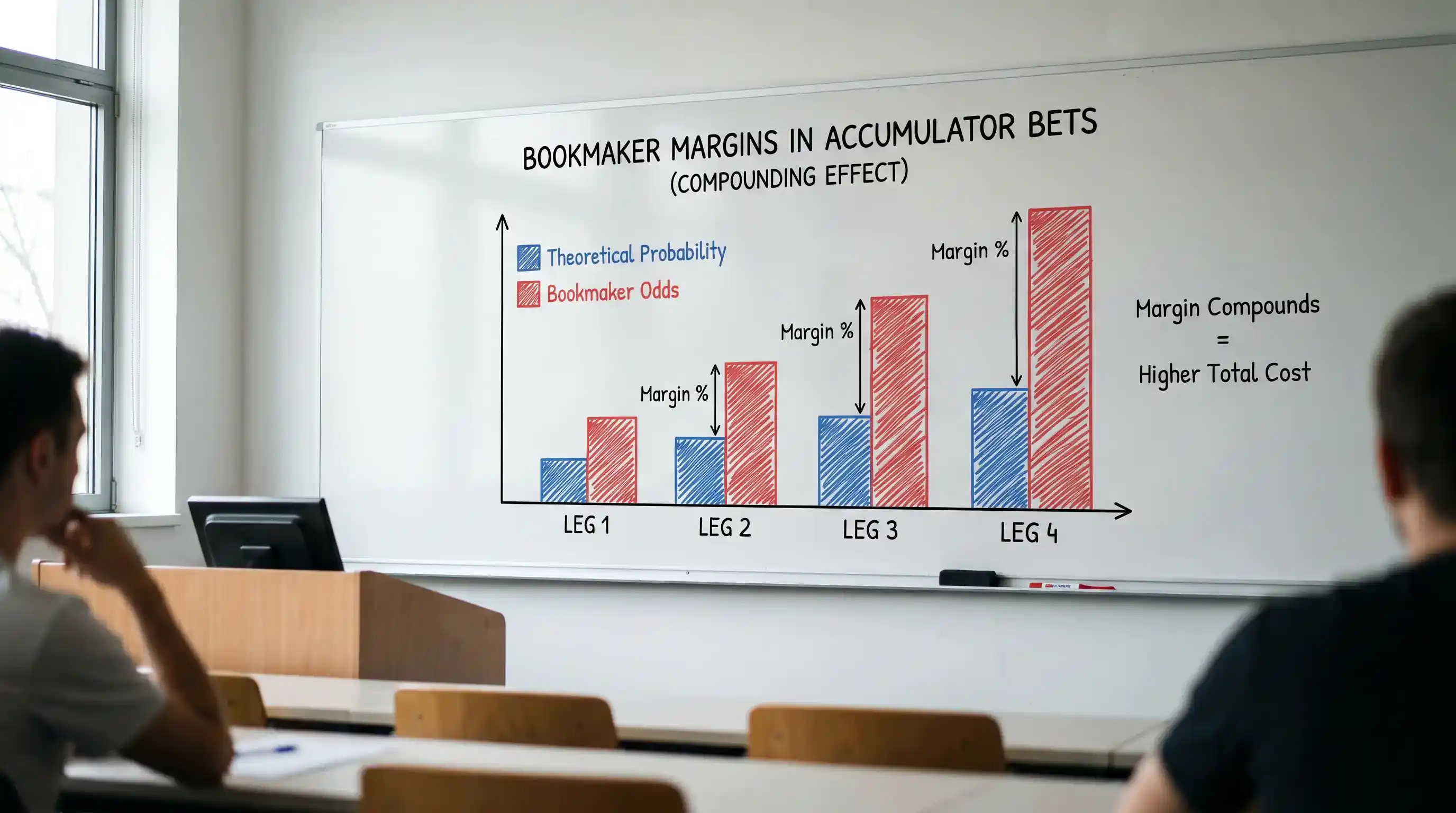

My rule is simple: three to four legs maximum. Beyond four, the probability of all legs landing is too low to offer positive expected value at the odds typically available. I know this contradicts the popular appeal of five-, six- or seven-leg accas, but the data is clear. Over nine seasons, my three-leg accas have returned a positive ROI. My four-leg accas are approximately break-even. Anything beyond four legs has been consistently negative.
The market type matters as much as the number of legs. Handicap selections are my preferred acca ingredient because the odds cluster around even money (1.85-2.00), which means each leg carries a meaningful probability of landing. Match-winner selections on heavy favourites — odds of 1.20 or 1.30 — look safe individually but offer almost no value in combination. A four-leg acca of 1.25 favourites pays only 2.44, and a single upset wipes the entire return. I would rather take four handicap bets at 1.90 each for a combined price of 13.00, where each leg represents genuine analytical conviction.
Totals selections make poor acca components because the variance in rugby scoring is high. A totals leg that you assess at 58% probability adds a 42% chance of failure to your acca, and the odds on totals (typically 1.85-1.95) do not compensate for the additional risk they inject into the combination. I include a totals leg only when the edge on that individual selection is unusually strong.
Correlation Between Legs and Why It Can Help You
In a traditional multi-match acca, the bookmaker assumes that each leg is independent. The result of one match does not affect the result of another. That assumption is usually correct — but not always, and the exceptions create value.

Weather correlation is the most reliable example. If three Premiership matches are being played on the same afternoon in the same region of England, and that region is experiencing heavy rain, the under is more likely to land in all three matches simultaneously. The bookmaker prices each over/under independently, but the weather is a shared factor that increases the correlation between outcomes. A three-leg unders acca on rainy-weather matches has a higher combined probability than the individual leg probabilities would suggest, because the legs are positively correlated through the weather variable.
Scheduling correlation works similarly. If two sides in your acca are both playing their third match in ten days, fatigue is a shared factor that increases the probability of both sides underperforming their season averages. A handicap acca that backs the opposition in both fatigued fixtures benefits from the positive correlation between fatigue-driven underperformance.
I do not overweight correlation — it is a secondary factor, not a primary selection criterion. But when I have identified value in multiple selections that share a correlated driver, I am more willing to combine them in an acca because the combined probability of all legs landing is higher than the naive multiplication would suggest.
Bankroll Allocation for Accumulators
How much of your bankroll should accumulators consume? I allocate no more than 10-15% of my weekly rugby betting budget to accas. The remainder goes to single bets, where the expected value is clearer and the variance is lower. Accumulators are a supplement, not a strategy.

Within that allocation, I size individual acca stakes at 0.5-1% of my total bankroll. A three-leg acca at combined odds of 6.00 needs only a small stake to produce a meaningful return if it lands, and the small stake limits the damage when it does not. UK bookmakers collectively handle around 290 million online bets per month, and a significant portion of acca losses come from bettors who oversize their stakes on long-odds combinations because the potential payout is seductive.
Cash-out discipline is part of bankroll management for accas. If two of your three legs have landed and the third is live, the bookmaker will offer a cash-out price that locks in a guaranteed profit. Whether to accept depends on the cash-out price relative to the expected value of letting the bet run. If the cash-out offers 70% of the full payout and your model says the final leg has a 60% chance of landing, the expected value of continuing is 60% times full payout — which may or may not exceed the cash-out offer. I make this calculation explicitly rather than relying on instinct, because instinct in cash-out situations is biased toward the certainty of the guaranteed profit. For a broader look at managing your overall betting funds, rugby bankroll management covers the principles that keep your betting sustainable across all bet types.
A Saturday Afternoon Acca Built With Discipline
Let me walk through a real-world example of how I build a rugby acca. It is a Saturday in November, four Premiership matches on the card. I have run my model on all four and identified value in three selections: Side A -3.5 at 1.92 (my model says 57% probability), Side B +7.5 at 1.88 (my model says 56%), and under 42.5 in a fixture where persistent rain is forecast (my model says 62%).

Each selection meets my single-bet threshold for value — I would place each as a standalone bet regardless of the acca. The combined odds are 1.92 times 1.88 times 1.90, which equals approximately 6.86. The combined probability of all three landing, assuming independence, is 57% times 56% times 62% = 19.8%. The break-even probability at combined odds of 6.86 is 14.6%. My estimated probability of 19.8% exceeds break-even by over five percentage points. The acca has positive expected value.
I stake 0.75% of my bankroll. If it lands, the return is meaningful. If it does not, the loss is manageable. And critically, each leg was selected for its individual merit before being combined — I never add a leg to an acca just to boost the odds. The moment you include a selection you would not bet individually, you have crossed from structured betting into lottery thinking.
How many legs should a rugby accumulator have?
Three to four legs is the optimal range for rugby accas. Each additional leg multiplies the bookmaker’s compounding margin and reduces the probability of all selections landing. Over a season-long sample, three-leg accas produce the best balance between enhanced odds and realistic landing probability. Beyond four legs, the expected value turns negative for most bettors.
Should I cash out an accumulator early if most legs have landed?
Compare the cash-out offer to the expected value of letting the bet run. If the remaining leg has, say, a 60% chance of winning and the full payout would be significantly higher than the cash-out offer, the expected value favours continuing. If the remaining leg is marginal and the cash-out offer represents a good return on your stake, taking the guaranteed profit is rational. Make the decision based on numbers, not nerves.
Created by the ”Rugby Betting Tips” editorial team.